Parts and contaminants · 4 min read · Updated 2026-09-26
Ultrasonic cleaning of heat exchangers in industry
Scale, oil, biofilm and deposits on plate packs, tube bundles and coolers cost heat transfer and pumping energy. Which heat exchangers can go into an ultrasonic tank and which cannot, the two-step chemistry for scale and oil, tank sizes for plates and bundles, and the checks before the exchanger goes back into service.
Technical guide. Figures are taken from our own spec tables; for your process we confirm the settings with a cleaning trial.
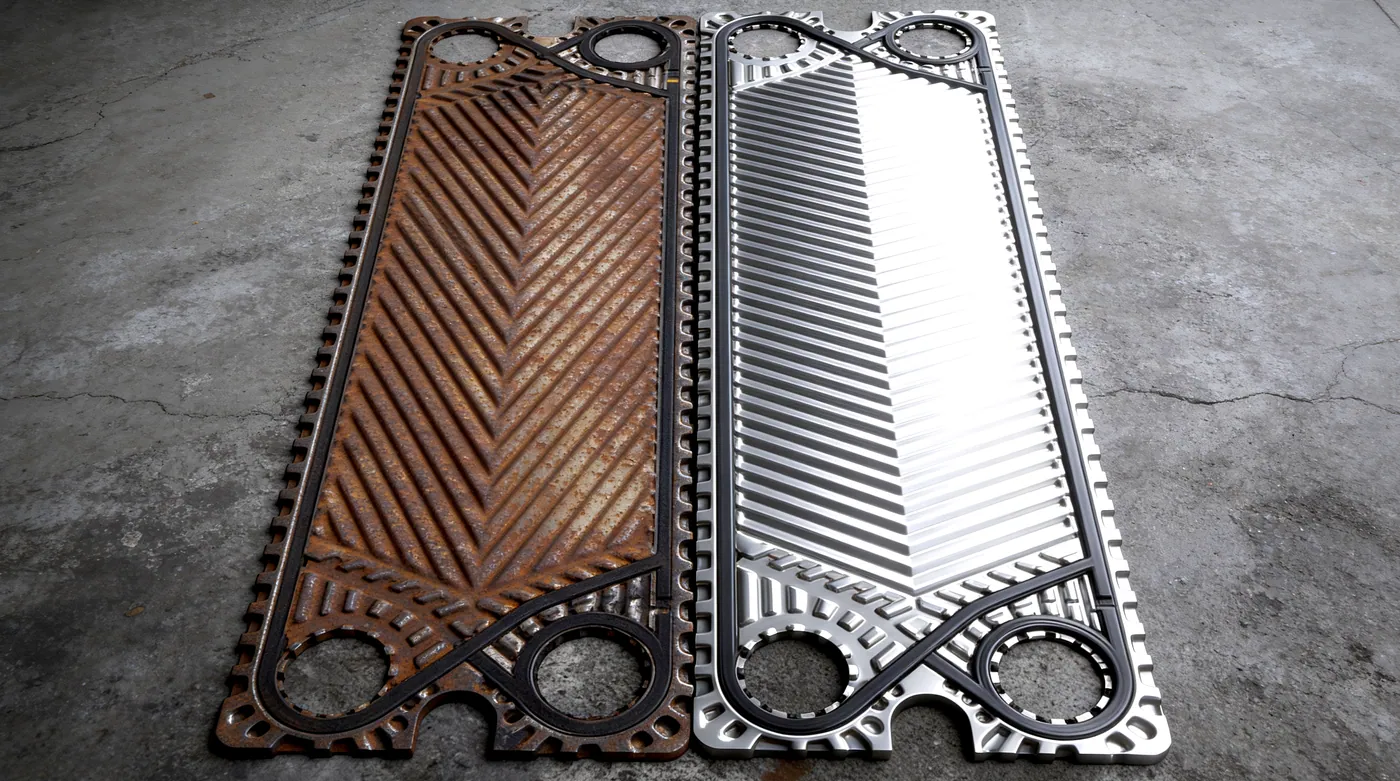
A heat exchanger loses performance long before it stops working. A fraction of a millimetre of scale or an oil film on the plates reduces heat transfer and raises the pressure drop, so the plant uses more energy, more cooling water and more pump power for the same duty. Cleaning in place, by circulating a chemical through the exchanger, works for light fouling. For heavy scale, packed deposits and exchangers that can be opened, taking the parts out and cleaning them in an ultrasonic tank is faster and more thorough.
Which heat exchangers fit
| Type | Ultrasonic cleaning |
|---|---|
| Gasketed plate heat exchangers | Yes, the typical case. The plates come out of the frame and go into the tank in racks |
| Removable tube bundles (shell and tube, U-tube) | Yes, in a tank long enough for the bundle. The outside of the tubes cleans well; see the note on tube interiors below |
| Oil coolers, hydraulic and gearbox coolers, compact bar-and-plate coolers | Yes, as a unit |
| Finned coils and air coolers | Often, if the fins are strong enough and the coil fits |
| Brazed or welded plate heat exchangers that cannot be opened | Not effectively. The channels are closed; they are cleaned by circulation |
| Fixed tube-sheet exchangers | No; cleaned in place or by mechanical tube cleaning |
Tube interiors. Liquid inside a tube cavitates too, provided the tube is completely filled and has no trapped air. The effect weakens towards the middle of a long, tightly packed bundle, because the outer tubes shield the inner ones. Long bundles are therefore turned or cleaned in stages, and heavily blocked tubes are opened mechanically first.
Two kinds of fouling, two steps
Most exchangers carry both an organic and an inorganic layer: oil, grease or biofilm on one side, scale on the other, or both together on the same surface.
| Step | Removes | Liquid | Temperature | Time |
|---|---|---|---|---|
| 1. Alkaline wash | Oil, grease, biofilm, organic deposits | alkaline cleaner 3 to 5 % | 55 to 65 °C | 20 to 40 min |
| Rinse | Cleaner | clean water | warm | 5 min |
| 2. Descaling | Calcium carbonate, iron oxide, mineral scale | acidic descaler, often phosphoric, citric or sulfamic acid based | 40 to 60 °C | 15 to 45 min |
| Rinse and neutralise | Acid residue | water, then a mild neutraliser if the supplier specifies it | warm | 5 to 10 min |
The order matters: alkaline first, because the acid cannot reach scale that is covered by oil. Acidic descalers and anything containing chloride do not go directly into a 304 stainless tank; they pit it from under deposits on the floor. Use an acid-resistant insert tank, a second tank in AISI 316, or a separate descaling tank; see tank material and direct and indirect cleaning. Check that the descaler suits the plate material: titanium, stainless steel and copper-brazed parts each have their own limits, and gaskets are best removed or confirmed compatible first.
Handling plates and bundles
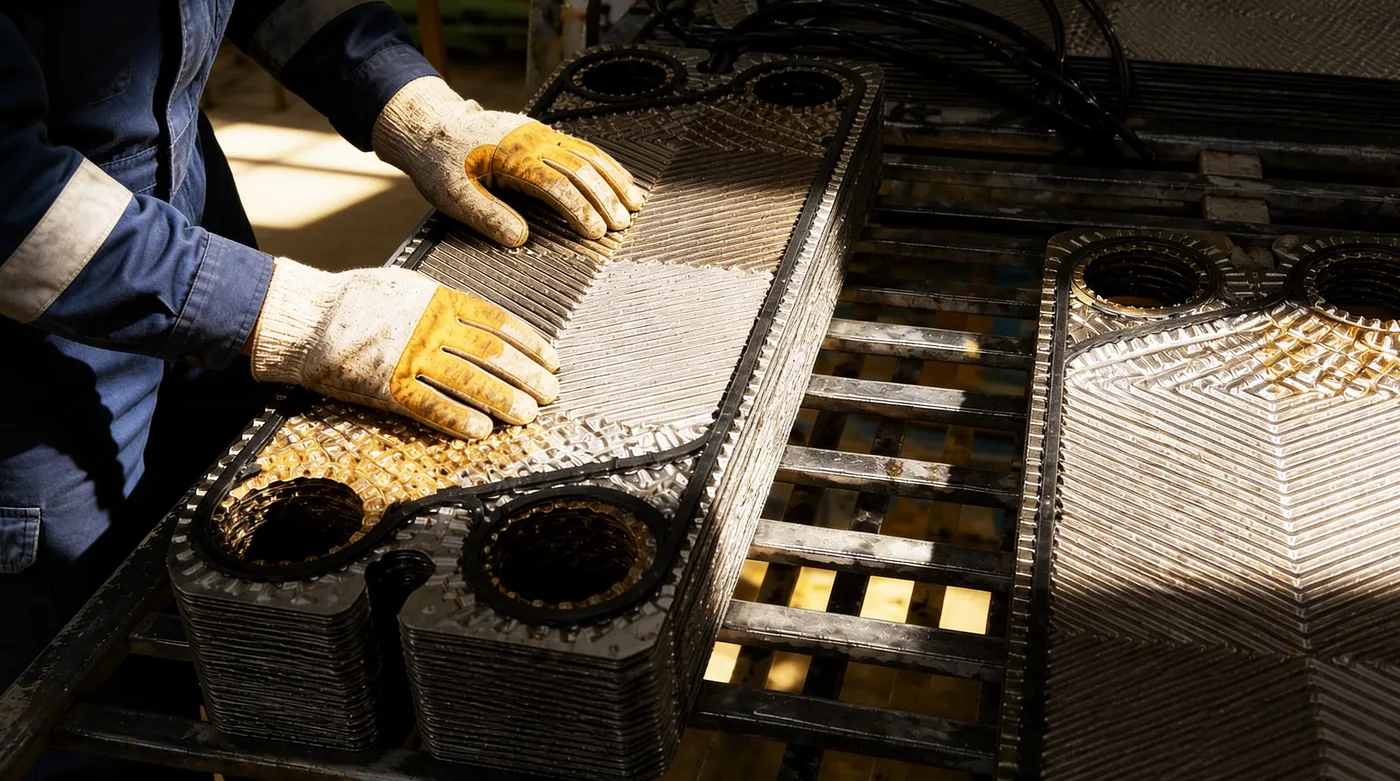
- Plates go into a rack that holds them upright and apart, 20 to 50 plates per load depending on size. Plates that lie on top of each other shield each other and do not clean.
- Bundles are heavy and long. A lift system or crane lowers them into the tank and moves them during the cycle, which also pumps liquid through the tubes; see when to choose a lift system.
- Tank size follows the largest part: plate height and width, or bundle length and diameter, plus clearance. The volume follows from that, not the other way round. See how to size a tank.
Which machine
| Work | Set-up |
|---|---|
| Oil coolers and small plate packs, maintenance | ST-157 to ST-300 at 28 kHz, rack, rinse tank, separate descaling insert |
| Plate heat exchangers as a service, regular | AL-600 or AL-1000 with lift and rack, alkaline tank, descaling tank in 316, rinse station |
| Tube bundles and large coolers | AU-2000 to AU-8000 with the servo platform, or a custom tank sized to the bundle with crane handling |
Large exchangers are usually a custom layout. The quote checklist lists what we need: the largest part's dimensions and weight, the fouling, the materials and the number of units per year.
Before it goes back into service
- Inspect plates and tubes for corrosion, pitting and cracks. Clean plates show defects that were hidden under the scale.
- Replace gaskets that are hard, cracked or flattened.
- Pressure-test or leak-test the reassembled exchanger to the maker's procedure.
- Record the pressure drop and outlet temperatures after start-up. Compared with the values before cleaning, they show the gain, and they tell you when the next cleaning is due.