Parts and contaminants · 4 min read · Updated 2026-09-30
Ultrasonic cleaning of medical tubing, cannulas and channels
Inside a narrow lumen nothing flows unless something pumps it. How to clean cannulas, tubes and drilled channels in production, and prove the inside is clean.
Technical guide. Figures are taken from our own spec tables; for your process we confirm the settings with a cleaning trial.
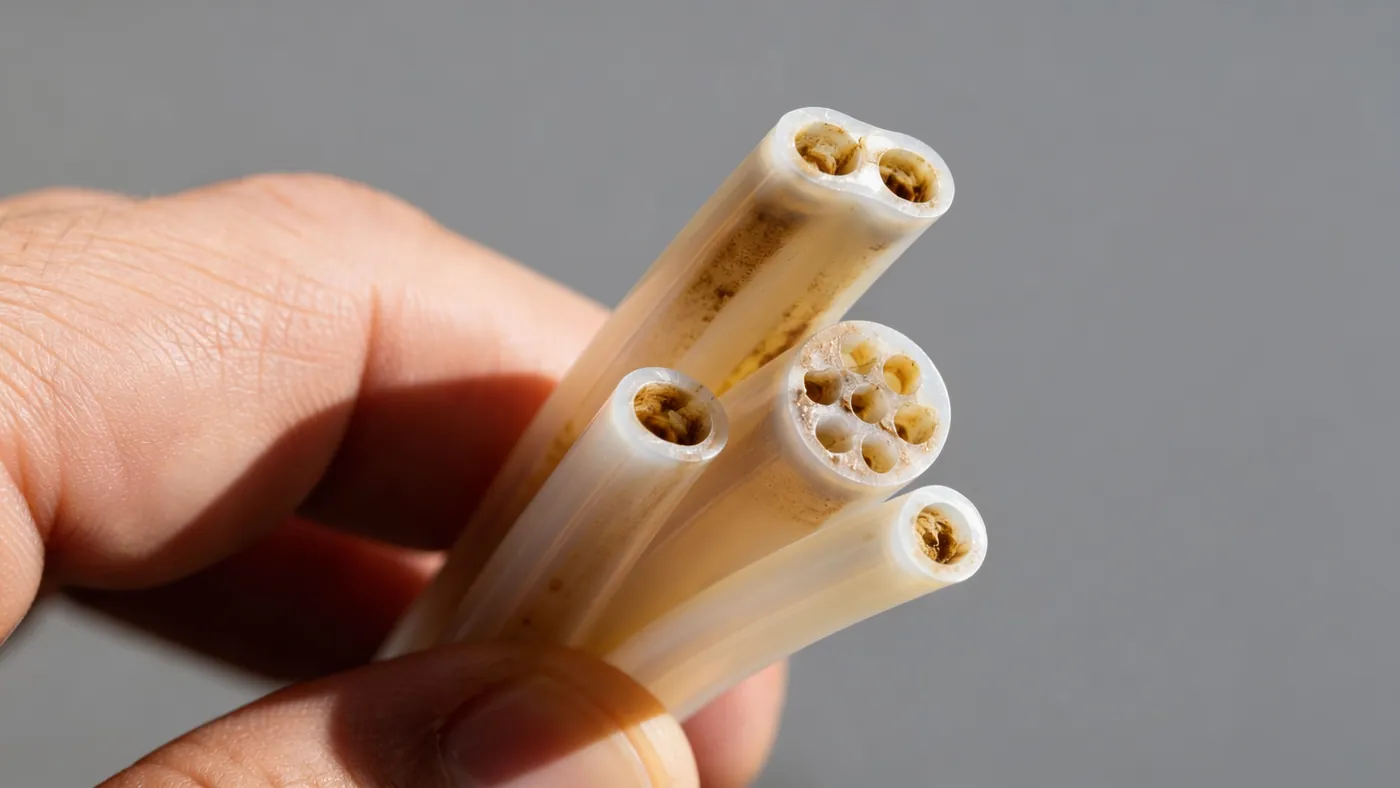
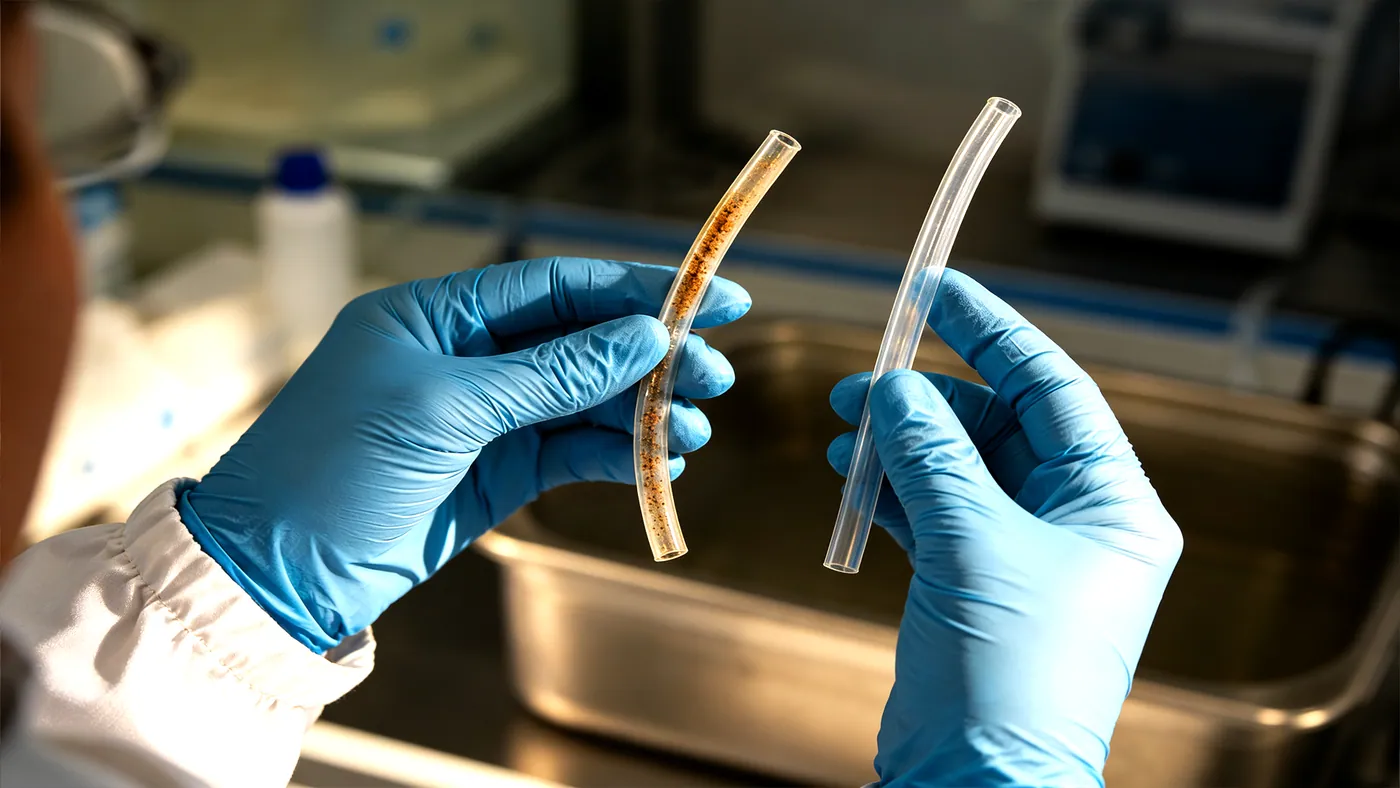
Hypodermic tubing, biopsy needles, trocar and cannula sleeves, suction tubes, cannulated screws and drills, drilled channels in instrument shafts, polymer catheter tubing: in medical device manufacturing a large share of parts have a lumen. The outside of such a part is as easy to clean as any other surface. The inside is not. Drawing lubricant, grinding residue from tip grinding, recast particles from laser cutting and chips from cross-drillings sit in a channel that may be a millimetre wide and a hundred times as long.
Scope. This article covers manufacturing. Reprocessing of endoscopes and other lumened devices in hospitals uses equipment certified for that purpose, endoscope washer-disinfectors to EN ISO 15883-4, and follows the device maker's reprocessing instructions under EN ISO 17664. In the EU, such reprocessing equipment is itself a medical device under Regulation (EU) 2017/745, Article 2(1). Sonixtek machines are industrial cleaning equipment, not certified as medical devices, and are not used for it.
Why lumens are hard to clean
Air. A tube lowered horizontally into a bath keeps its air. Where there is air there is no liquid, and where there is no liquid there is no cavitation. Tubes go in at an angle, lower end first, so the liquid pushes the air out, and a fresh bath is degassed first. The same physics applies to blind holes; see threaded parts and blind holes.
Sound. The ultrasound reaches the inside through the wall and the open ends. In a narrow bore the cavitation is weaker than in the open bath, and the longer and narrower the channel, the less the bath alone achieves. Blind channels are the worst case.
Exchange. Cavitation loosens residue, but inside a lumen the liquid does not move, so the loosened particles stay where they are. They come out only with flow.
That is why tubes and channels are cleaned with ultrasound and flushing together:
- Lift agitation. Moving the basket up and down with the parts angled pumps liquid through open channels on every stroke; see agitation.
- Flushing manifold. Tubes connected to a manifold, for example by Luer fittings, with a pump driving filtered cleaning liquid through every lumen during the ultrasonic cycle. The manifold is designed around the part family; for special tanks and integrated options, see custom units.
- Alternating steps. Ultrasound to loosen, then a flush to carry out, repeated.
Burrs come off before cleaning
Ultrasonic cleaning removes loose particles and loosely attached ones. It does not remove a burr still attached at a cut end or a cross-hole; that burr breaks off later, in the product. Tubes are deburred first, and electropolishing is often used on stainless tubing to remove burrs and smooth the inside. The order is cut, deburr, clean, electropolish, clean, rinse, dry. The hydraulic valve blocks article explains the same principle for drilled channels.
The sequence
| Station | Purpose | Typical setting |
|---|---|---|
| Ultrasonic wash with flushing | Lubricant, grinding residue, particles | Alkaline cleaner with inhibitor for stainless, 50 to 60 °C, 40 kHz, 5 to 15 min |
| Rinse with flushing | Carry-out of cleaner and loosened particles | Clean water, ultrasound on |
| Final rinse | No residue inside the lumen | Purified water flushed through every lumen |
| Blow-out | Water out of the channels | Filtered compressed air through each lumen |
| Dry | No moisture left inside | Hot air, with air flow through the lumens where possible |
Polymer tubing is cleaned at a lower temperature, within the limits of the material, with a neutral or mild alkaline cleaner. Silicone and some other elastomers absorb cleaning agents, so the rinse is longer. Drying a long tube by warming the outside is slow; air has to move through the inside. See rinsing and drying.
Proving the inside is clean
The outside can be inspected by eye; the inside cannot. Common methods in validation and routine checks:
- Flush extraction: a measured volume of clean liquid is flushed through the lumen, filtered through a membrane, and the particles are counted and sized or the residue weighed.
- Organic residue: total organic carbon or conductivity measured in the flush liquid.
- Visual: a borescope in larger bores; for validation, sample tubes cut open lengthwise and inspected under a microscope.
- Flow check: the flow rate through each lumen at a set pressure shows blocked or partly blocked channels.
The cleaning is a process validated under the manufacturer's quality system (ISO 13485). The worst case in the validation is the longest, narrowest channel with the most residue, and it is the one that sets the cycle.
Which machine
| Work | Set-up |
|---|---|
| Needles, cannulas, short tubes in small batches | UMX Pro 50L at 40 kHz, fixture holding the parts at an angle, rinse tank |
| Series of cannulated screws, drills and instrument shafts | AL-75 or AL-150: the lift pumps liquid through the channels, with filtration |
| Final clean of small tubular parts | MT-75: 75 L wash at 40 or 80 kHz, with rinse and dry in one frame |
| Long straight tubes | Tank length sets the choice: ST-300 has a 900 mm tank, ST-400 1,100 mm; longer tubes need a custom tank |
Whatever the machine, the fixture that holds and flushes the tubes is designed around the part family, and it matters as much as the tank. See also components before assembly and the medical industry overview.