Industries · 4 min read · Updated 2026-11-18
Ultrasonic cleaning of power plant components
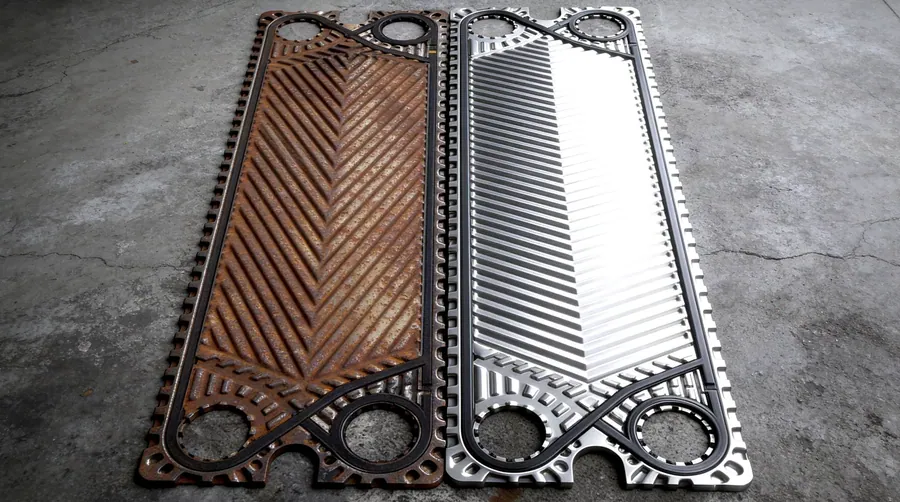
During an outage, valves, heat-exchanger plates, strainers, bearings and engine injector parts come out of the plant and go to the workshop. What is on them, which cleaner and settings remove it, and which tank fits. Installed equipment and boiler tubes stay with other methods.
An ultrasonic tank cleans what can be lifted into it. In a power plant that means the components removed during an outage or overhaul and taken to the workshop: valve internals, heat-exchanger plates and small tube bundles, filter elements, bearings, control-oil parts and the injector parts of gas and diesel engines. Boiler tubes, installed exchangers and pipework stay where they are and are cleaned by chemical circulation, jetting or mechanical methods. The tank is one step in the overhaul procedure; the equipment maker's cleaning, inspection and reassembly instructions still apply.
The parts
- Valve internals: plugs, seats, stems, cages, and the bodies of smaller valves.
- Heat-exchanger parts: gasketed plates from plate heat exchangers, tube bundles of oil and air coolers once pulled from the shell.
- Filters and strainers: stainless mesh and sintered metal elements, strainer baskets.
- Bearings and bearing housings, pump impellers and seal parts.
- Turbine and compressor blades and vanes removed during an overhaul.
- Control and lubricating-oil components: servo and governor valve parts, small manifolds.
- Engine parts from gensets: injector nozzles, pump elements, cylinder-head parts.
The soil
| Soil | Where it comes from | Where you find it |
|---|---|---|
| Scale and mineral deposits | hardness in cooling and process water | exchanger plates, cooler tubes, strainers |
| Oil, grease and varnish | lubricating and control oil | bearings, servo valves, gearbox parts |
| Corrosion products | water, steam, flue gas | valve internals, impellers |
| Carbon | combustion | injector nozzles, engine parts |
| Fouling and biofilm residue | untreated or stagnant water | cooler and exchanger surfaces |
| Dust, fly ash, particles | the plant environment | filters, housings, electrical hardware |
The chemistry
Each soil needs its own cleaner, and some parts need two stages.
- Oil, grease and varnish: an alkaline degreaser. Varnish from turbine and control oil is stubborn and needs a strong alkaline cleaner, heat and time.
- Scale and mineral deposits: an acidic descaler, chosen for the base metal. Strong acids attack carbon steel, copper alloys and aluminium; the cleaner maker states which metals each product suits. After an acid stage, rinse thoroughly and, where the procedure asks for it, neutralise.
- Mixed oil and scale: degrease first, then descale. Oil on the surface keeps the acid from reaching the scale.
- Biofilm residue: alkaline cleaning removes the deposit. Cleaning does not disinfect; if the water side needs treatment, that is a separate step.
Rinse, dry and protect bare carbon steel at once. A descaled steel surface rusts quickly in a humid workshop.
Frequency, temperature and time
28 kHz for robust parts with heavy, hard deposits: scale on exchanger plates and strainer baskets, corrosion on valve internals, carbon on engine parts. 40 kHz for fine detail: servo valve spools and bores, injector nozzles, fine mesh filters, bearings.
Alkaline degreasing runs best at 55 to 70 °C
Load plates upright in a rack with space between them, so the sound field reaches both faces. Filter elements need flushing after the ultrasonic stage to carry the loosened particles out of the mesh.
Which Sonixtek machine
| Work | Machine | Useful space and load |
|---|---|---|
| Injector parts, servo valves, small bearings | ST-40 to ST-96 | baskets from 380 × |
| Valve internals, impellers, strainer baskets | ST-206 to ST-400 | 28 or 40 kHz; baskets to 1070 × |
| Heavy valve bodies, bearing housings, coolers | AL-300 to AL-2000 with lift | 820 × |
| Large exchanger plates, big tube bundles | AU-2000 to AU-8000 | to 2800 × |
| Pre-wash of heavy loose dirt | SPR rotating spray washer | rotating baskets from Ø 750 to Ø 1250 mm |
| Drying | DT hot-air dryers | 96 to 300 L |
The industrial series heat from room temperature to 100 °C
Tell us the largest part and its soil, and we will propose a tank and a trial.