
Parts and contaminants · 3 min read · Updated 2026-09-26
Removing carbon deposits from engine valves
Intake valves on direct-injection petrol engines and exhaust valves on every engine carry hard carbon on the tulip and stem. How to clean valves once the head is off, keep each valve with its guide, and tell a cleaned valve that can be refaced from one that is scrap.
Technical guide. Figures are taken from our own spec tables; for your process we confirm the settings with a cleaning trial.
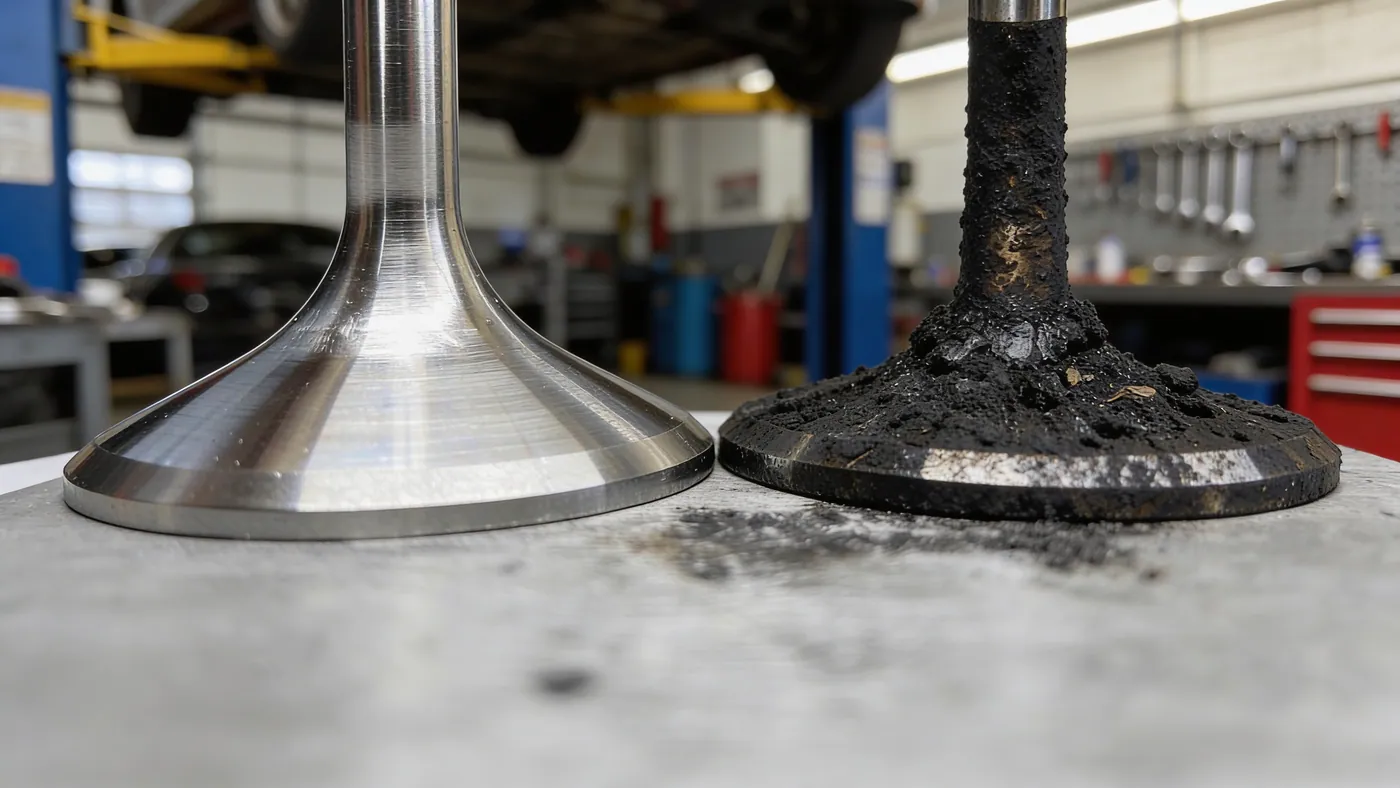
Every engine valve cokes, but two kinds are notorious. Exhaust valves sit in the hottest gas in the engine and carry a hard, brittle carbon on the face and the underside of the head. Intake valves on direct-injection petrol engines never see fuel washing over them, so oil mist from crankcase ventilation bakes onto the back of the tulip and the stem into a thick crust that restricts airflow. Once the head is off for a rebuild, the valves come out and are cleaned before anyone decides whether they can be reused.
Keep them in order
Valves are lapped or ground to their own seats and wear to their own guides. Put them into a numbered rack as they come out of the head, and clean them in a basket insert that keeps that order. A pile of sixteen clean valves that nobody can match back to their guides is sixteen valves that must be reground.
The bath
Liquid. Heavy-duty alkaline carbon remover at 5 to 10 %. Valves are steel or nickel alloy with hardened stems and often stellite-faced seats; the metal is not at risk from the chemistry, only from long cycles at 28 kHz on the polished stem.
Temperature. A 15-minute soak at 80 to 90 °C with the ultrasound off softens oily carbon; then 65 to 70 °C for the ultrasonic stage, where cavitation is strong. See removing carbon deposits.
Frequency. 28 kHz for the tulip deposits.
Time. 20 to 30 minutes. Intake valves from direct-injection engines, with thick oily crust, clean well. Exhaust valves with glassy, hard deposits come out with most of the carbon gone and a thin, hard layer left that a soft wire wheel or glass-bead blast finishes; ultrasound first means seconds on the wheel instead of minutes.
Loading. Valves lie flat in a rack or stand stem-down in a holder, spaced so the tulips do not shield each other; see loading the basket.
After the bath
- Rinse and dry at once; valve stems are precision-ground and must not rust.
- Inspect: stem wear and bend, face burning and pitting, margin thickness. A valve whose margin is below the maker's minimum after refacing is scrap, however clean.
- Reface or lap to the seat, then clean again to remove grinding grit and lapping compound, which must not go into the engine.
- Oil the stems before refitting to their guides.
Which machine
A set of valves fills a small basket. Where the valves come out of heads that are cleaned anyway, they go into the same tank in an insert basket; see cylinder heads.
| Work | Machine |
|---|---|
| Valves alone, a set at a time | STS-300 benchtop or ST-40 at 28 kHz with a valve rack |
| Valves with the heads, rebuilder | ST-96 to ST-206 or an AL-300, valves in an insert basket |
| Batches of valves for remanufacturing | ST series with a filtration loop, rinse and dryer |
In the engine, without removing the head
Direct-injection intake valves are also cleaned on the car, by blasting walnut shell through the intake ports with the valves closed. That is a different job for a different tool. An ultrasonic bath only applies once the valves are out.