
Parts and contaminants · 3 min read · Updated 2026-09-26
Ultrasonic cleaning of cylinder heads for automotive repair
Carbon in the chambers and ports, oil sludge under the cam covers, scale in the water jacket, gasket remains on the deck. How a head is stripped, which bath suits aluminium and which suits cast iron, and where cleaning sits between crack testing and valve-seat work.
Technical guide. Figures are taken from our own spec tables; for your process we confirm the settings with a cleaning trial.
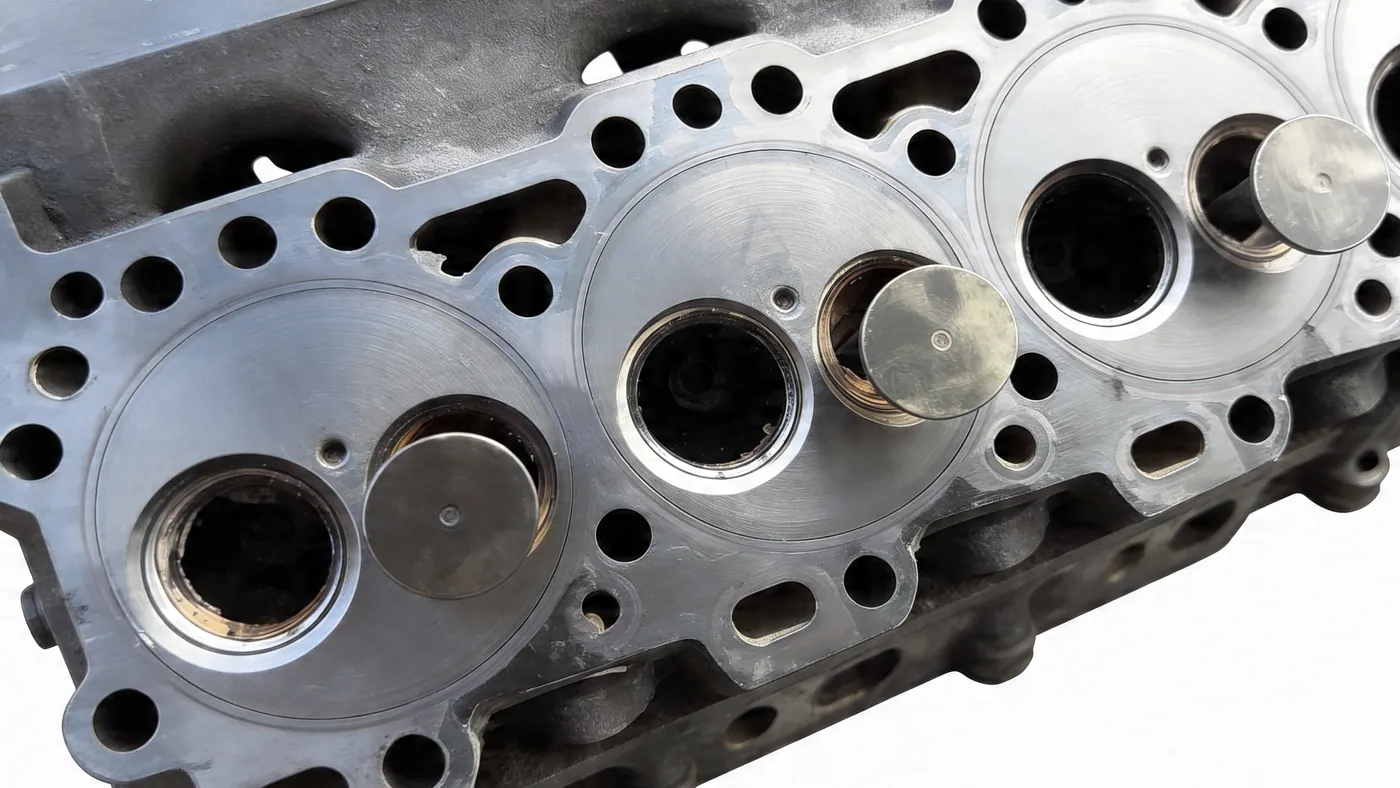
A cylinder head comes into the workshop with three kinds of dirt in three places. The combustion side carries carbon in the chambers, around the valve seats and in the exhaust ports. The top carries oil sludge under the camshafts, in the lifter bores and in the oil drillings. The water jacket carries coolant scale and corrosion product. Each has to be gone before the head can be tested, measured and machined, and each is out of reach of a brush somewhere.
Where cleaning sits in the job
- Strip: camshafts, followers, valves, springs, seals, injectors and glow plugs out. Valves go into a numbered rack so each one returns to its guide.
- First clean: carbon, sludge and scale off, so cracks and warping are visible.
- Crack test and measure: dye penetrant or magnetic particle test, deck flatness, guide and seat wear.
- Machine: skim, valve seats, guides.
- Final clean: chips and cutting oil out of the ports, drillings and bolt holes.
- Assemble.
The first clean removes the soil; the final clean protects the assembled engine. The same tank does both, ideally with a bath change in between.
The bath
| Head | Liquid | Temperature | Frequency | Time |
|---|---|---|---|---|
| Aluminium (almost every car head) | inhibited alkaline carbon remover for light alloys | 60 to 65 °C | 28 kHz | 20 to 40 min, with agitation |
| Cast iron (many diesel and older heads) | heavy-duty alkaline carbon remover | 65 to 75 °C | 28 kHz | 30 to 45 min, soak 15 min first |
| Final clean after machining, either metal | mild alkaline cleaner with inhibitor | 55 to 60 °C | 28 or 40 kHz | 10 to 15 min |
Watch the time on aluminium. A light-alloy cleaner still removes metal if the head is left in it for an hour, and the first thing to suffer is the machined deck. Two cycles with a look in between are safer than one long one.
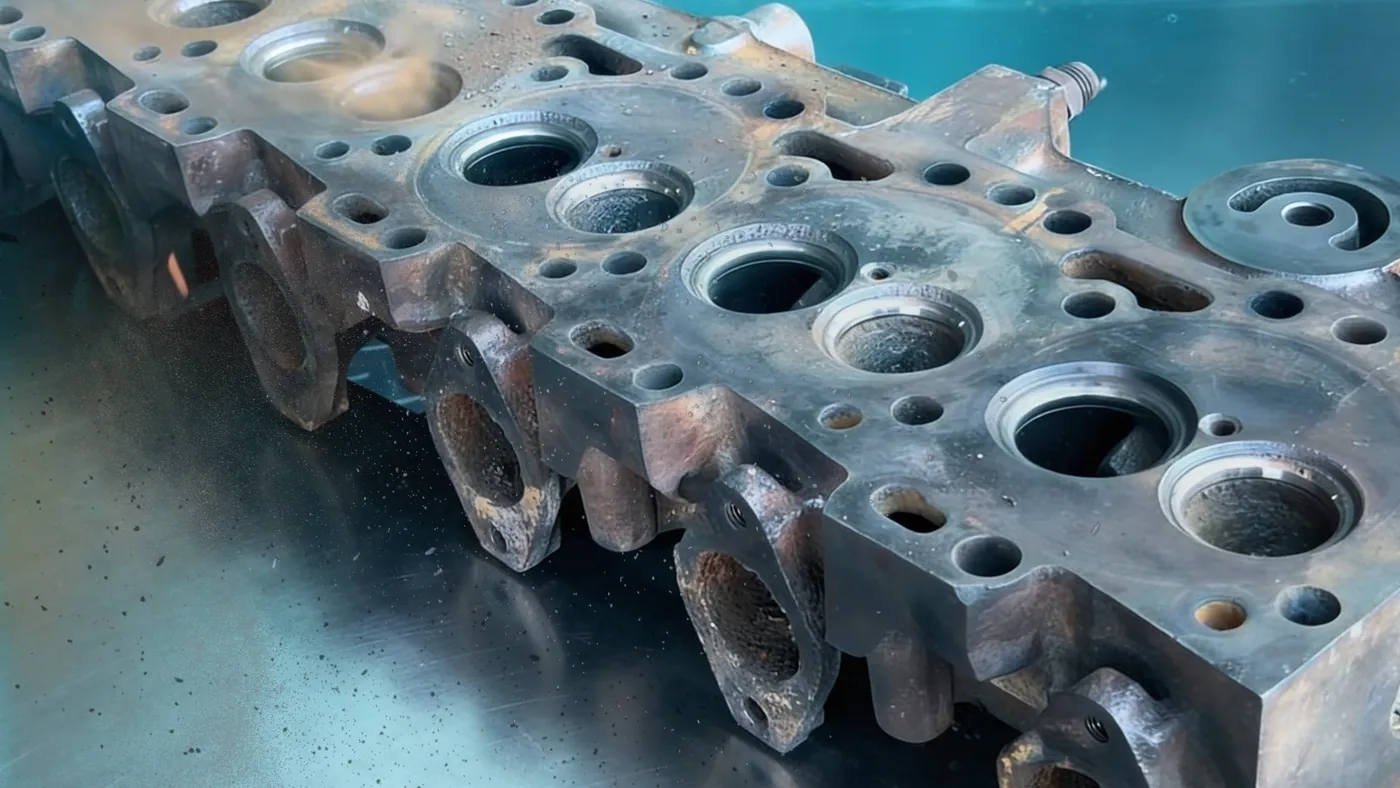
Loading
- Combustion side down or on edge, so loosened carbon falls away and air escapes from the ports.
- Water jacket openings sideways or down, so the scale that comes loose can drain.
- Valves, springs and small parts in a separate insert basket, in their order.
- On a lift with agitation: the stroke pumps liquid through the ports and the water jacket, which a static basket does not.
Gasket remains
Composite gasket residue softens in a hot alkaline bath and comes off the deck with a plastic scraper afterwards. Multi-layer steel gaskets leave little. Never scrape an aluminium deck with steel, and never use abrasive discs on it: they remove metal and leave grit behind.
After the bath
Rinse in warm water, blow through every oil drilling and water passage, dry in hot air or blow dry, and protect: aluminium is fine left dry, cast iron needs oil or an inhibitor within the hour. Then crack test, while the surfaces are clean and dry; dye penetrant needs a surface free of oil to show anything.
Tank sizes
A four-cylinder car head is roughly 450 × 250 × 150 mm and 10 to 20 kg; an inline six about 650 × 250 × 150 mm; a V8 head half that length; a truck head one-piece up to a metre and 100 kg or more. With the usual 20 mm around the part, a four-cylinder head fits the 580 × 380 × 200 mm basket of the ST-96, a V head fits the ST-157, and an inline six needs the 730 mm basket of the ST-206.
| Work | Machine | Useful basket space | Load |
|---|---|---|---|
| Garage, four-cylinder heads | ST-96 | 580 × 380 × 200 mm | 100 kg |
| Engine rebuilder, inline six and V heads | ST-157 for V heads; ST-206 or an AL-300 with lift for inline six | 680 × 480 × 260 mm to 820 × 520 × 340 mm | 100 to 200 kg |
| Truck heads, batches of heads | AL-600 or AL-1000 with agitation and filtration | 1170 × 710 × 470 mm, 1420 × 720 × 570 mm | 300 kg, 750 kg |
For carbon in general see removing carbon deposits; for the valves that come out of the head, carbon on engine valves.