
Parts and contaminants · 3 min read · Updated 2026-09-26
Ultrasonic cleaning of diesel injectors in the workshop
Carbon at the nozzle, tar from blow-by on the body, lacquer inside. How common-rail injectors are prepared, which parts go in the bath and which never do, the liquid, temperature and time, and why the test bench has the last word.
Technical guide. Figures are taken from our own spec tables; for your process we confirm the settings with a cleaning trial.
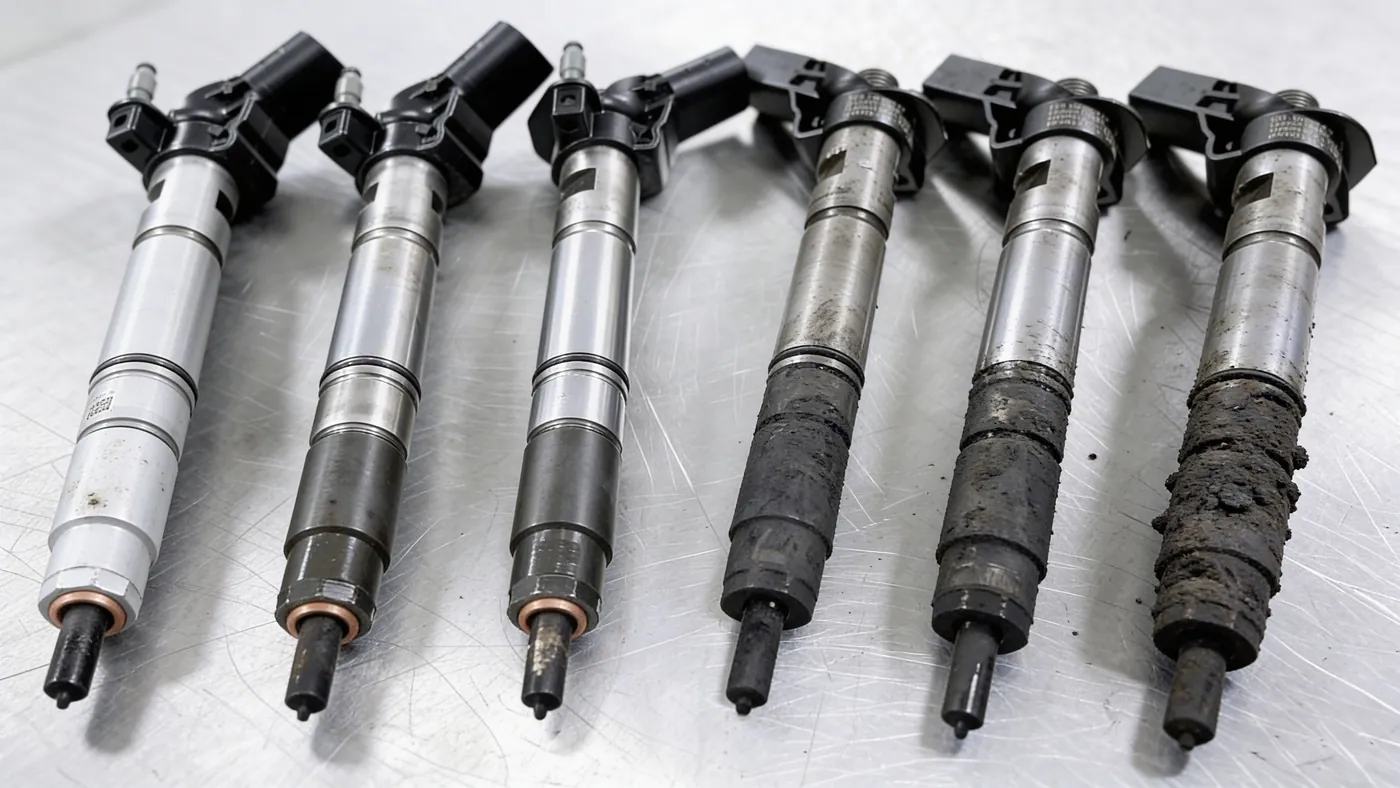
A common-rail injector works at 1600 to 2500 bar, meters fuel through six to ten holes of about 0.1 mm, and opens and closes several times per combustion cycle. Everything that makes it precise also makes it sensitive to dirt. The workshop meets three kinds, in three places, and each needs a slightly different treatment.
Three deposits
- Coke at the nozzle tip. The tip sits in the combustion chamber. Fuel that dribbles after shut-off, or a poor spray, cokes around the holes and narrows them. The spray pattern breaks up, the injector returns out of tolerance on the bench, and the engine smokes.
- Tar on the body from blow-by. If the copper sealing washer under the injector no longer seals, combustion gas leaks up past the nozzle and bakes a black, sticky crust on the injector body and in the head bore, the deposit mechanics call "black death". It locks the injector in the head and keeps leaking until the washer and the seat are cleaned.
- Lacquer and particles inside. Degraded fuel, water and wear debris lacquer the control valve and the needle guide. That is the job of a full rebuild on a test bench, not of a bath alone.
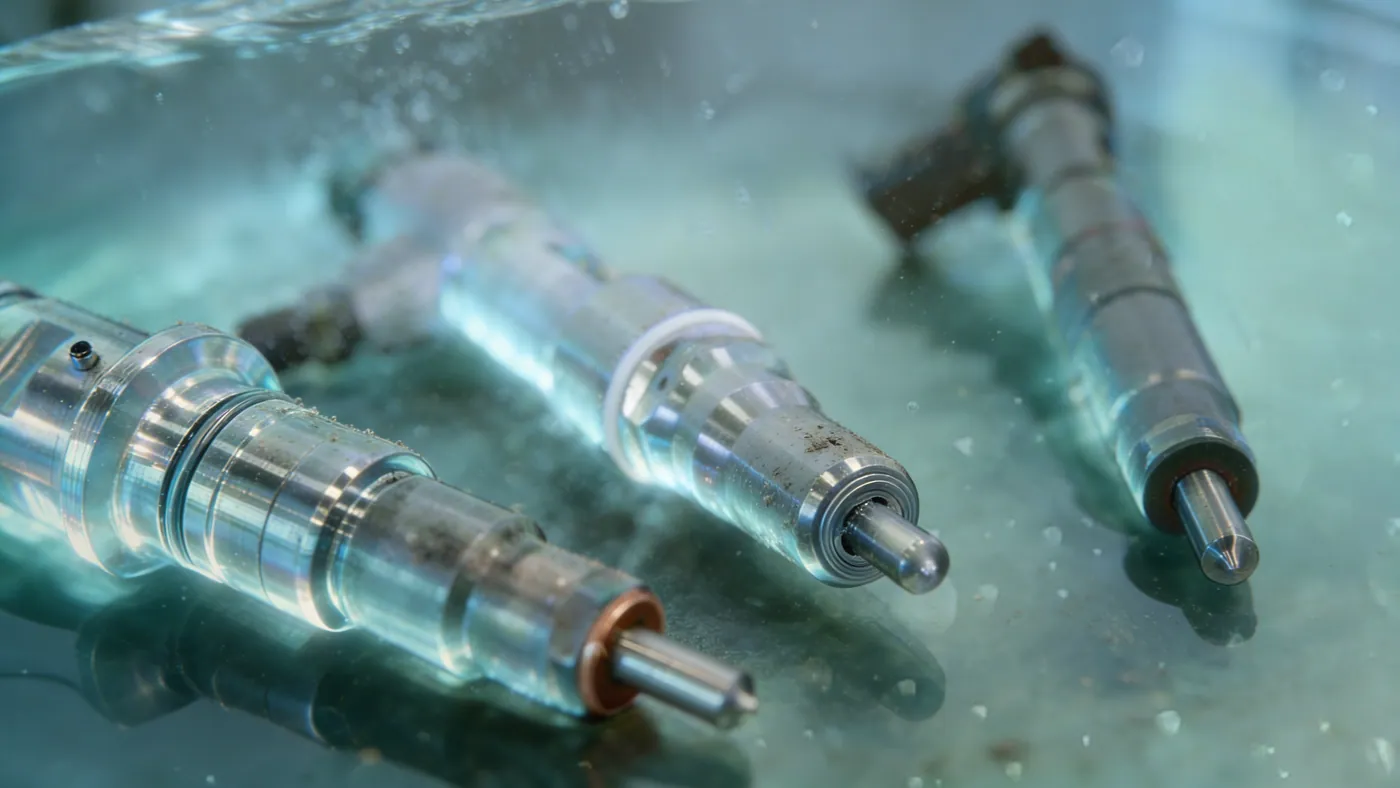
Preparing the injector
- Test first on the common-rail bench: delivery at full load, idle and pilot, and return quantity. The readings before cleaning decide whether the injector is cleaned, rebuilt or replaced.
- Remove the copper washer, the O-rings and the edge filter where it is replaceable. Seals are always renewed.
- Protect the electrical end. Solenoid injectors tolerate immersion of the body; piezo injectors and every connector must stay out of the liquid. Stand the injectors in a rack with the connector above the surface, or clean only the lower half.
- For a rebuild, the nozzle is unscrewed from the body. The needle and its nozzle body are a matched pair lapped to a few microns: they go into the basket together, in a divided tray, and are never swapped.
The bath
| Deposit | Liquid | Temperature | Frequency | Time |
|---|---|---|---|---|
| Coke at the tip, nozzle only | carbon remover for steel | 60 to 70 °C | 40 kHz | 10 to 20 min |
| Tar on the body (blow-by) | carbon remover, soak first | 65 to 70 °C | 28 or 40 kHz | 20 to 30 min, soak 15 min before |
| Nozzle and needle, rebuild | injector or diesel cleaning fluid | 50 to 60 °C | 40 kHz | 5 to 10 min |
40 kHz is the default: the holes are fine and the needle seat is a lapped surface. 28 kHz is worth it only for heavy tar on the outside of the body, with the nozzle protected. Degas a fresh bath before the first injector, see sweep and degas.
After the bath
- Rinse in clean test fluid, not water; water left in a nozzle corrodes the needle within hours.
- Blow dry with filtered air and put the nozzle straight back together or into clean test fluid.
- Test on the bench against the specification. Cleaning restores flow through coked holes; it does not restore a worn needle seat or an eroded hole. The bench shows which it was.
- Clean the seat in the head before refitting, with a seat cutter or brush and new copper washer, or the blow-by returns.
Which machine
| Work | Machine |
|---|---|
| Service workshop, a set of four to six at a time | STS-150 or STS-300 benchtop, 40 kHz, injector rack |
| Injector specialist, rebuilds daily | UMX Pro 50L or 62L with stored programmes per injector type, or two benchtop units, one for nozzles and one for bodies |
| Remanufacturing in batches, with fixtures and baskets | SF-225 with filtration and skimmer, or an AL series lift system, with separate rinse and dry stations beside it |
Diesel residues load the bath with a fine black suspension; a filter of 10 µm or finer on a circulation loop keeps it from redepositing in the holes. See filtration and bath life. For petrol injectors, which are cleaned differently, see petrol fuel injectors; for carbon in general, removing carbon deposits.