Ultrasonic cleaning basics · 3 min read · Updated 2026-09-25
Ultrasonic power density: watts per litre, and why big tanks need fewer
Divide the ultrasonic power by the tank volume and you get the figure that predicts how hard a tank cleans. Our range runs from about 9 to 40 W per litre, and the spread is deliberate. How to read the number when comparing machines.
Technical guide. Figures are taken from our own spec tables; for your process we confirm the settings with a cleaning trial.
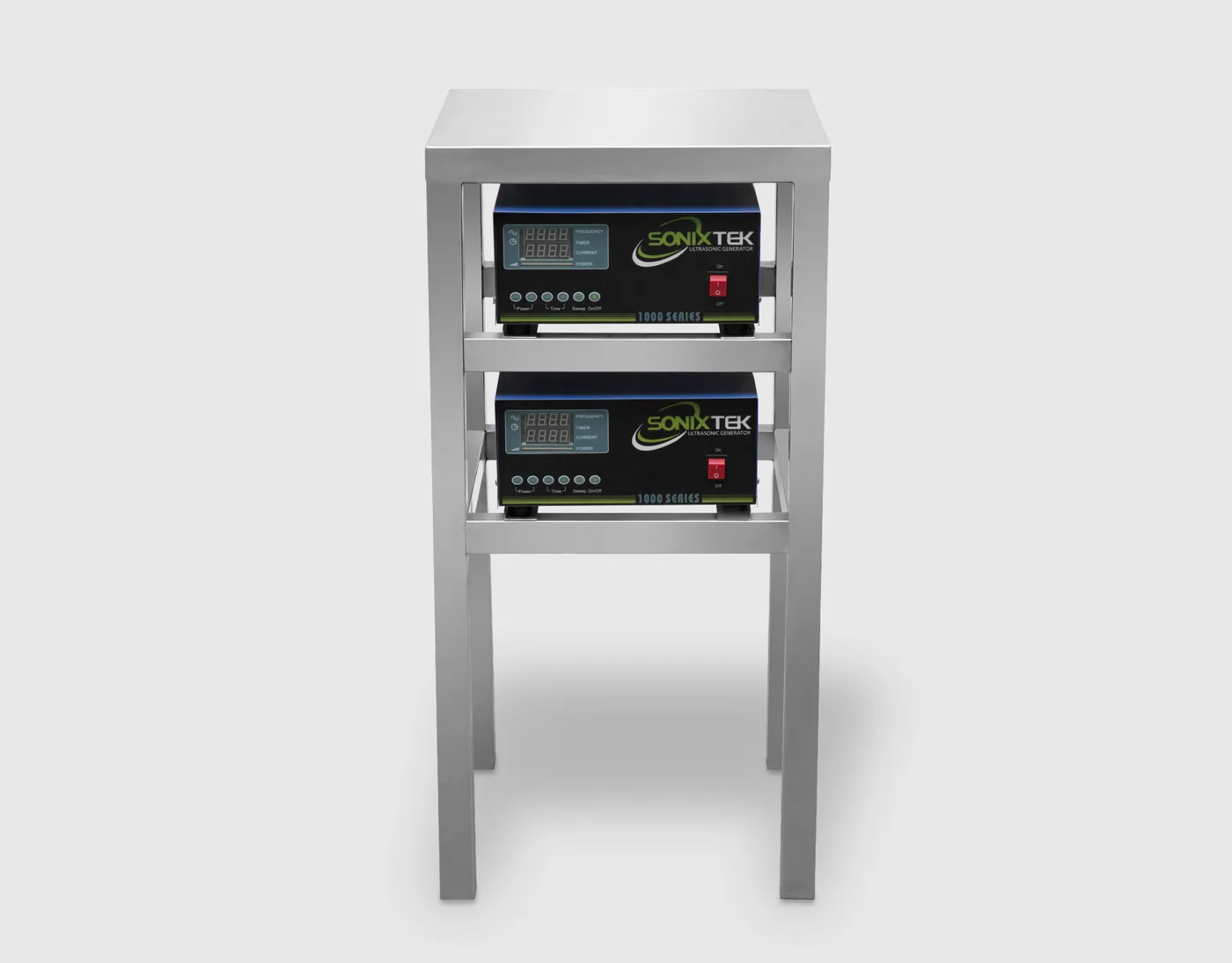
Two tanks of the same volume can clean very differently, and the first number to compare is not the ultrasonic power on the nameplate but that power divided by the litres it has to drive. Power density, in watts per litre, tells you how much cavitation energy each litre of liquid receives.
Our range, in watts per litre
| Model | Volume | Ultrasonic power | W per litre |
|---|---|---|---|
| STS-030 (benchtop) | 3 L | 120 W | 40 |
| STS-300 (benchtop) | 30 L | 600 W | 20 |
| ST-40 | 40 L | 720 W | 18 |
| ST-96 | 96 L | 1440 W | 15 |
| UMX Pro 88L | 88 L | 1440 W | 16 |
| UMX Pro 255L | 255 L | 3120 W | 12 |
| ST-400 | 400 L | 5760 W | 14 |
| AL-600 | 600 L | 7200 W | 12 |
| AL-2000 | 2000 L | 20 400 W | 10 |
| AU-8000 | 8000 L | 69 600 W | 9 |
The figures fall as the tank grows. That is not a compromise; it follows from how cavitation works.
Why the density falls with size
Cavitation happens at a threshold. Below a certain sound pressure no bubbles form; above it, more power makes more bubbles, but with diminishing returns, because the bubble cloud itself scatters and absorbs the sound. A small tank needs a high density because a large fraction of its volume is close to a wall, where the sound field is weakest, and because small parts are cleaned in short cycles where the first minute has to count. A large tank has a long path for the sound to build up, a bigger floor area for transducers, and parts that stay in for longer.
There is also a practical ceiling. Above roughly 25 to 30 W per litre in water the extra energy goes into heating the bath and eroding soft surfaces rather than into cleaning, and the transducer floor becomes crowded. The benchtop STS-030 sits at 40 W per litre because its 3 litres are meant for jewellery, small precision parts and laboratory glassware in cycles of a few minutes, where a hard field over a tiny volume is exactly what is wanted.
What the number does not tell you
- Field evenness. 1440 W spread over 24 transducers across the whole floor cleans more evenly than the same power from 12 larger transducers in the middle. Transducer count per square metre of floor matters as much as watts per litre.
- Depth. A deep tank with transducers only on the floor loses power towards the surface. Our deeper tanks carry transducers on the side walls as well.
- Frequency. At the same density, 28 kHz hits harder and 40 kHz reaches finer detail. See 28 or 40 kHz.
- Nameplate conventions. Some suppliers quote peak power, some quote average, and some quote the generator's input rather than what reaches the transducers. Our figures are the rated output of the generator to the transducers. When comparing, ask which is meant, and if in doubt ask for a foil test.
Using the figure when specifying
For general degreasing and machining swarf, 10 to 15 W per litre in a 28/40 kHz industrial tank is a working range, and our ST, UMX, AL and AU series are built around it. For heavy carbon on cast parts or for very short cycle targets, the upper end of that range or a smaller tank than the part strictly needs. For delicate parts in a benchtop unit, the higher densities of the STS range are normal and the cycle is kept short. If a part fits a 96-litre tank but the load is light, the ST-96 will clean it faster than an ST-206 at the same fill, simply because the same class of power is driving fewer litres.
The tank sizing guide starts from the part; this figure is the second check once the size is known.