
Parts and contaminants · 4 min read · Updated 2026-09-26
Cleaning engine blocks after machining
Boring, honing and decking leave chips, abrasive grit and honing oil in bores, galleries and blind holes, and one grain in an oil gallery can wipe a new bearing. How rebuilders and remanufacturers clean a machined block, with the tank sizes and loads that fit car and truck blocks.
Technical guide. Figures are taken from our own spec tables; for your process we confirm the settings with a cleaning trial.
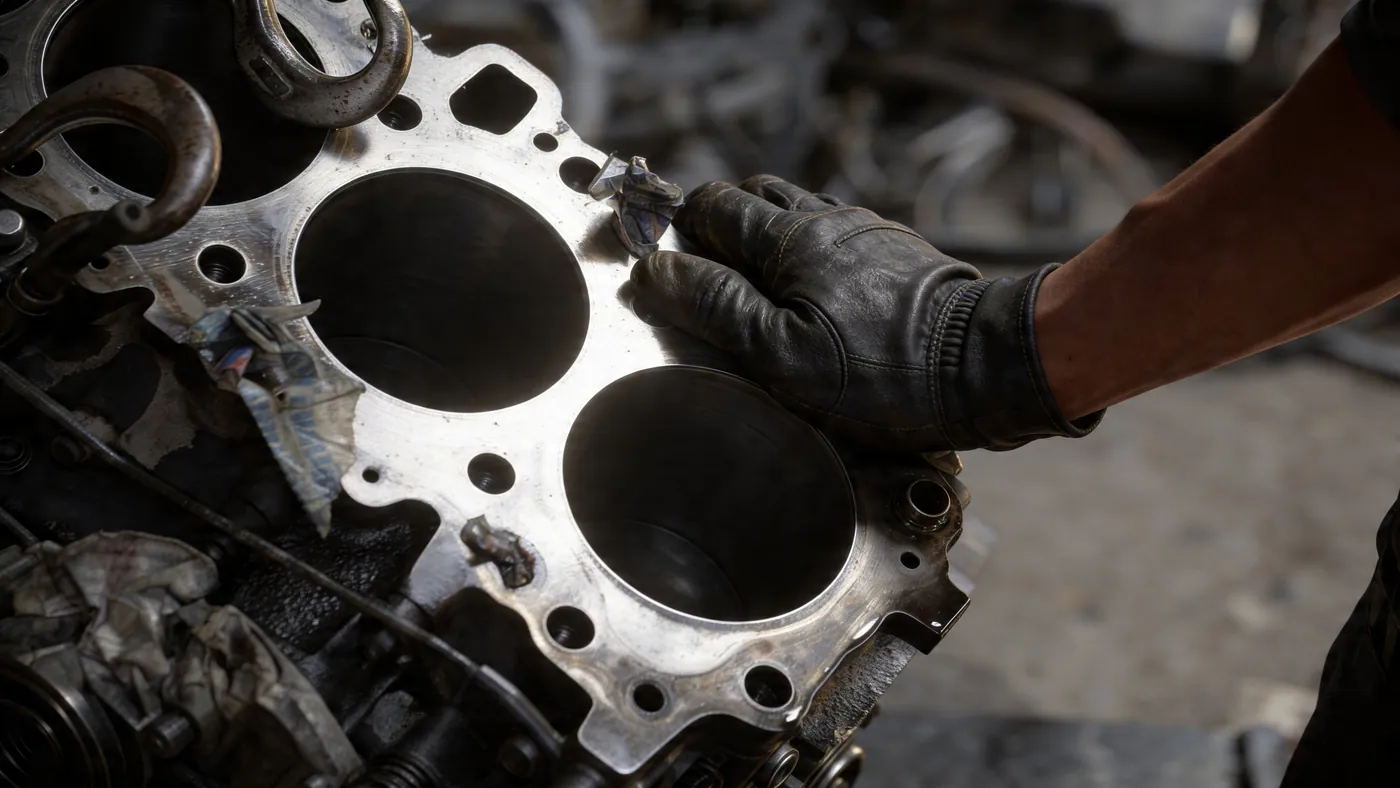
An engine block is cleaned twice in a rebuild. The first time, before machining, the aim is to see it: old oil, sludge and gasket remains come off so the block can be crack-tested and measured. The second time, after machining, the aim is to protect the new parts: every chip from the boring bar, every grain of abrasive from the hone and every drop of honing oil has to be out before a bearing shell or a piston ring goes in. The second clean is the one that decides whether the engine lives.
What machining leaves behind
- Chips from boring, decking, line-boring and thread repair, in the bores, the water jacket and every blind tapped hole.
- Honing grit: silicon carbide or diamond particles and bonded abrasive, pressed into the crosshatch of the cylinder wall. It is the most dangerous residue, because it embeds in bearings and rings and keeps cutting.
- Honing and cutting oil, which holds the grit on the surface and in the galleries.
- Particles in the oil galleries, carried in by the machining coolant and trapped in the cross-drillings to the main bearings.
A brush and a pressure washer clean the open surfaces. They do not clear a 10 mm gallery a metre long with two cross-drillings, the threads of forty blind holes, or the valleys of a honed crosshatch.
Preparing the block
- Remove all plugs: core plugs, gallery plugs and cam bearing plugs. The liquid must flow through every passage, and particles must have a way out.
- Remove cam bearings and any sensors still fitted.
- Run a brush through each oil gallery before the tank, to break the chip plugs loose.
- Load the block on its side or end, whichever lets the galleries and the water jacket drain, with the blind tapped holes sideways or angled upward, never straight down: a hole facing down holds an air pocket and stays dirty. After lifting, tip the block so liquid and loosened chips run out of the holes.
The tank process
| Block | Liquid | Temperature | Frequency | Time |
|---|---|---|---|---|
| Cast iron | alkaline cleaner with corrosion inhibitor | 60 to 65 °C | 28 kHz | 15 to 25 min with agitation |
| Aluminium | inhibited light-alloy cleaner | 55 to 60 °C | 28 or 40 kHz | 10 to 20 min with agitation |
Agitation, the slow vertical stroke of the basket on a lift system, is what moves liquid through the galleries and water jacket while the cavitation loosens the grit. On a static basket the same block needs twice the time and is still worse inside. See agitation.
After the ultrasonic cycle:
- Rinse in clean warm water with the same agitation.
- Brush and blow every gallery again with compressed air and a clean gallery brush; what the tank loosened now comes out.
- Dry in hot air, or blow dry and move on at once.
- Oil the bores and machined faces immediately. Freshly honed cast iron flash-rusts within the hour in a humid shop.
- Check: a white lint-free cloth wiped through a bore and a gallery brush pushed through each passage should come out clean.
Tank sizes for blocks
Block sizes vary, but as a guide a bare four-cylinder car block is roughly 450 × 300 × 350 mm and 30 to 50 kg in cast iron; a V8 block about 600 × 600 × 450 mm and 70 to 90 kg; a six-cylinder truck block over a metre long and 200 to 400 kg.
| Blocks | Machine | Useful basket space | Load |
|---|---|---|---|
| Car four- and six-cylinder, occasional | AL-300 or AL-400 with lift | 820 × 520 × 340 mm, 1020 × 520 × 430 mm | 200 kg |
| Car blocks, daily, rebuilder | AL-600 with lift and agitation | 1170 × 710 × 470 mm | 300 kg |
| V8, truck and industrial blocks | AL-1000 or AL-2000 | 1420 × 720 × 570 mm, 1600 × 870 × 750 mm | 750 kg, 1000 kg |
| Remanufacturing line | AU-2000 to AU-8000 as the wash tank, rinse and dry as separate stations; for automatic transfer an MT multi-tank line under one carriage, built to order | to 2800 × 1740 × 880 mm (AU) | to 2000 kg (AU) |
The ST-206 and ST-300 have the floor area for a car block, but their baskets are 260 mm deep (730 × 530 × 260 mm and 870 × 570 × 260 mm), too shallow for a bare block with 20 mm around it; they suit heads and smaller parts. Size from the useful basket space, not the tank volume; the lift systems article explains the difference.
Filtration matters more here than anywhere
A block puts cast-iron fines and abrasive into the bath, and fines that stay in suspension redeposit in the next block's galleries. A filter loop of 10 to 25 µm with a magnetic pre-separator, and a bath-change schedule tied to the number of blocks, are part of the process, not an option. The AL series takes modular filtration; see filtration and bath life and machining swarf and coolant.
Before machining
The first clean, before crack testing and measuring, is a degreasing job: old oil, sludge and carbon. The same tank does it with a stronger alkaline cleaner and a hotter bath; see heavy grease on engine parts. Use a separate bath, or change the bath between the dirty and the clean job, so the old sludge does not end up in the finished block.