
Parts and contaminants · 4 min read · Updated 2026-09-26
Cleaning hydraulic valves and manifold blocks with ultrasound
A hydraulic manifold is a block of intersecting drillings, and every one of them must be free of chips, burr flakes and coolant before oil touches it. The cleaning sequence after deburring, the cleanliness targets, the equipment for new blocks and for repaired valves, and how to keep the clean block clean until it is plugged.
Technical guide. Figures are taken from our own spec tables; for your process we confirm the settings with a cleaning trial.
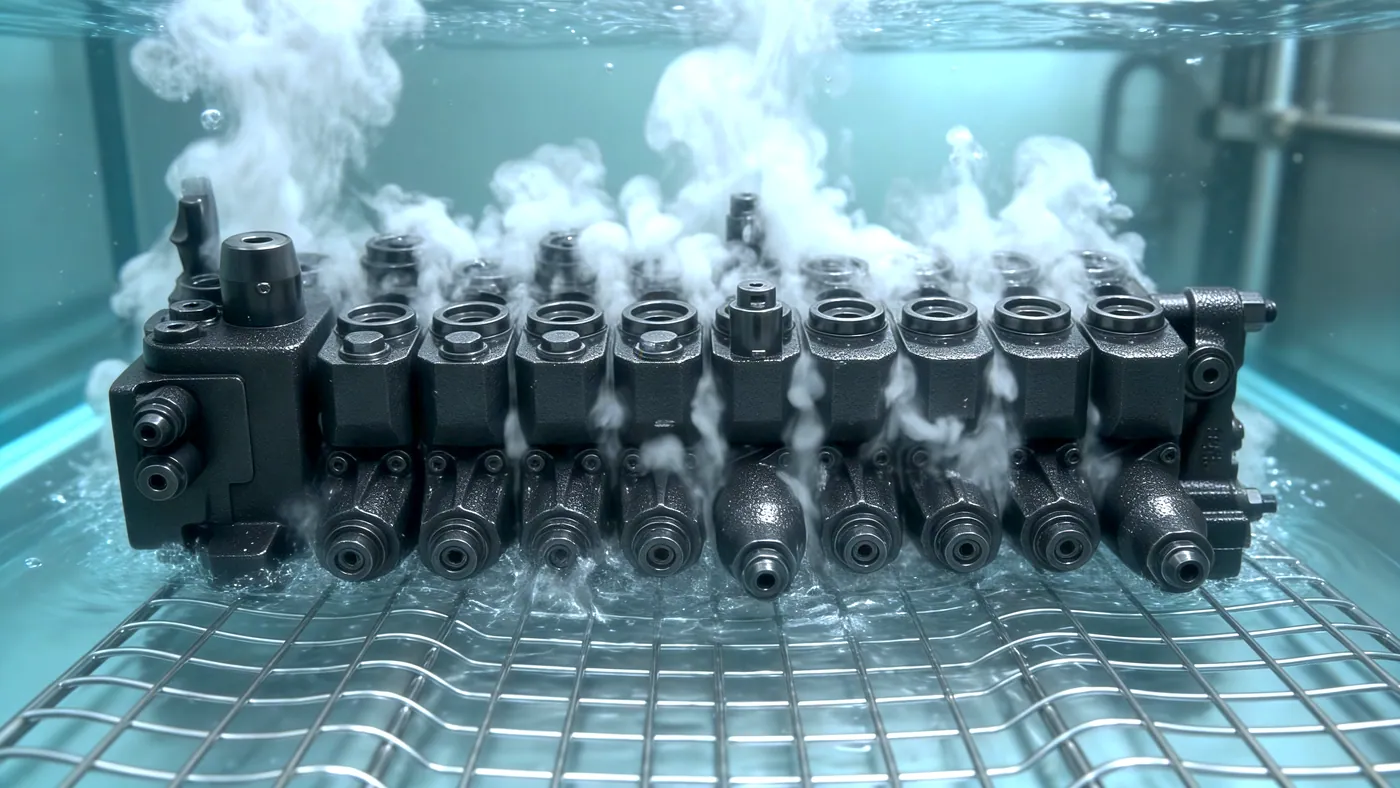
Most hydraulic failures start with a particle. A chip of a few tenths of a millimetre jams a spool, scores a valve seat or wears a pump; finer particles erode control edges over months. A lot of that contamination is built in: it comes from machining the manifold block, the valve body or the cylinder, and it sits in the drillings on the day the system is filled. Cleaning the block before assembly is therefore part of making the hydraulic system, and the cleanliness is specified like a dimension.
Why hydraulic blocks are hard to clean
A manifold block is a solid piece of steel, cast iron or aluminium with dozens of drillings that intersect inside it. Where two drillings meet, the drill leaves a burr on the edge. The block has cavities for cartridge valves, threaded ports, blind drillings closed later by plugs, and passages with changes of direction. Chips and coolant collect exactly where they are hardest to reach: the intersections, the bottoms of blind drillings and the undercuts of the cartridge cavities.
Deburr first, then clean
Ultrasonic cleaning removes loose particles and loosely attached ones. It does not remove a burr that is still attached at an intersection. Such a burr breaks off later, in service, which is the failure the cleaning was meant to prevent. So the order is:
- Machining, with good chip evacuation.
- Deburring of the intersections: brushing, high-pressure water, electrochemical deburring or thermal deburring, depending on the block.
- Ultrasonic cleaning of everything deburring loosened, plus coolant, fines and, after thermal deburring, the oxide ash it leaves in the drillings.
- Inspection and cleanliness testing.
- Plugging and protection of all openings.
The cleaning sequence
| Station | Purpose | Typical setting |
|---|---|---|
| Ultrasonic wash | Coolant, chips, deburring residue | Alkaline cleaner with inhibitor, 55 to 65 °C, 28 kHz, 10 to 15 min, lift agitation on |
| Ultrasonic rinse | Carry-out cleaner and loosened particles | Clean water, 40 to 50 °C, 28 or 40 kHz, 3 to 5 min |
| Final rinse | Inhibitor, spot-free | Demineralised water with corrosion inhibitor |
| Blow-out | Drain every drilling | Air lance port by port, or an automatic blow-off station |
| Dry | No water left in the drillings | Hot air at 80 to 90 °C, or vacuum drying for complex blocks |
Aluminium blocks use a light-alloy cleaner at 50 to 60 °C and shorter times. Blocks go in on a fixture that holds them at an angle so the drillings vent and drain; see threaded parts and blind holes. Moving the block up and down during the cycle pumps liquid through the drillings, which is why lift systems suit this work; see when to choose a lift system.
Cleanliness targets
Two standards come up in hydraulic work:
- ISO 16232 and VDA 19.1 describe how to test a component: extract the particles from a sample part, filter the extraction liquid through a membrane, then count and size the particles or weigh the residue. The customer's specification sets the limit, typically as a maximum particle size (for example no metallic particle larger than a few hundred micrometres) and a maximum residue mass per part or per wetted area.
- ISO 4406 gives the cleanliness code of the hydraulic oil itself, as particle counts at 4, 6 and 14 µm. A clean block is what lets a new system reach its target oil code without a long flushing run.
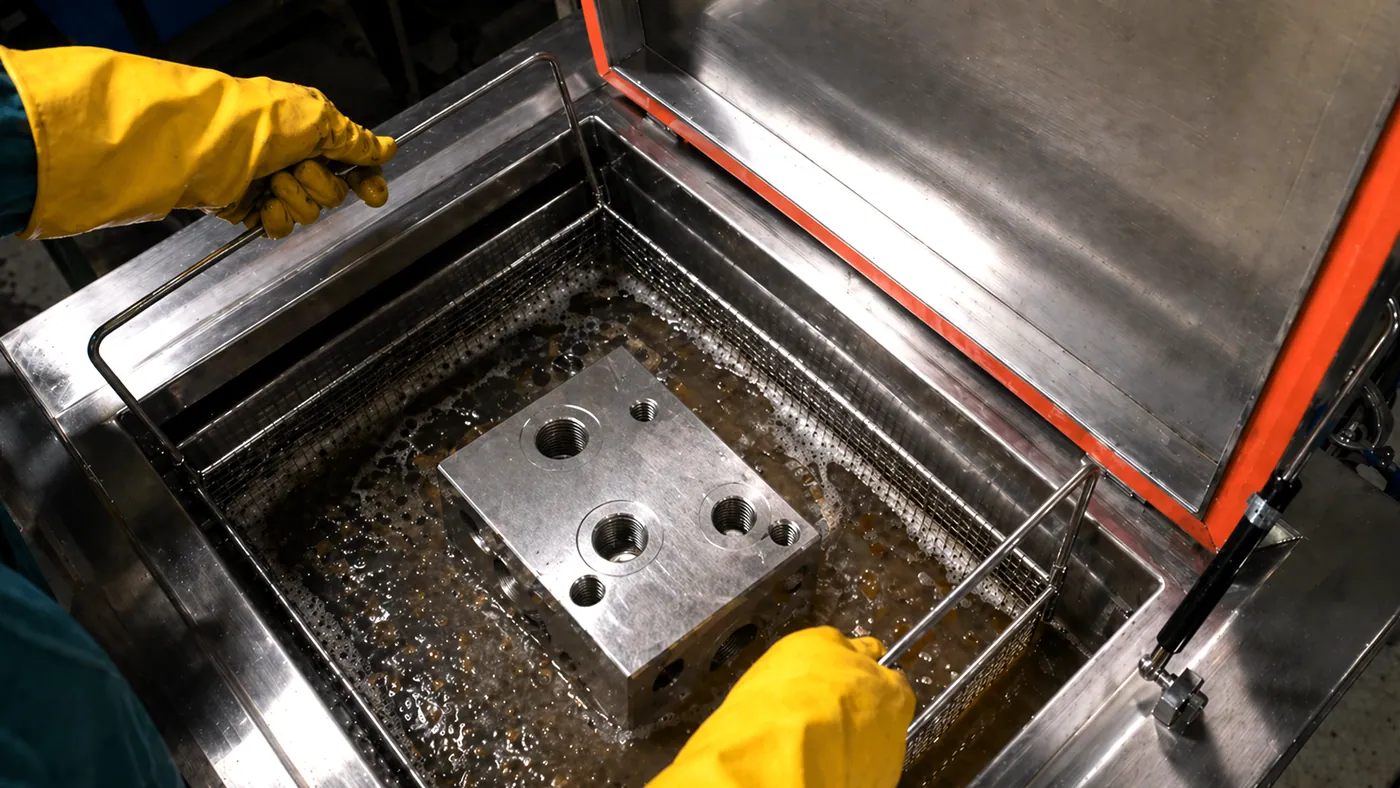
The cleaning station has to be stable enough that sample blocks keep passing the test. That depends less on ultrasonic power than on the bath: filtration fine enough to take out what the blocks bring in, a skimmer for the coolant oil, and a bath change on schedule rather than when the parts start to look dirty. See filtration and bath life.
Repair and overhaul
Valves and blocks from a repair are cleaned differently from new parts. They carry varnish, sludge and wear particles from years of oil, and sometimes water and corrosion.
- Strip the valve completely; seals and O-rings are replaced, not cleaned.
- Wash at 60 to 65 °C with a heavy-duty alkaline cleaner, 15 to 30 min; varnish may need two cycles.
- Clean spools and sleeves together as a matched pair, in a divided basket, at 40 kHz, so control edges are not damaged.
- Rinse, dry and oil the parts at once, and assemble in a clean area.
Which machine
| Work | Set-up |
|---|---|
| Repair shop, valves and small blocks | SF-225 with filtration and skimmer, ST rinse tank, DT dryer |
| Block production, batches | AL-150 or AL-300 wash with lift and filtration, rinse station, dryer |
| Series production to a cleanliness specification | MT multi-tank line: ultrasonic wash, ultrasonic rinse, demineralised rinse, blow-off and hot-air or vacuum dryer under one carriage |
After cleaning
Plug every port at once with clean plastic plugs or caps, not tape. Bag or cover the block if it waits for assembly. Assemble in a clean zone, away from machining and grinding. A block that passed the test and then waited open next to a grinder for a week has not passed.