
Parts and contaminants · 4 min read · Updated 2026-09-26
How to clean petrol fuel injectors with ultrasound
Port and direct injectors clog at the filter basket and the nozzle. What an ultrasonic bath cleans, why the injector has to be pulsed for the inside, which parts come off first, and the flow test that proves the result.
Technical guide. Figures are taken from our own spec tables; for your process we confirm the settings with a cleaning trial.
A petrol injector is a solenoid valve with a filter at one end and a metering orifice at the other. Varnish from old fuel narrows the orifice, carbon from the combustion side cakes on the tip, and particles stop at the inlet filter basket. The result is a lean cylinder, a misfire code, or an injector that drips after shut-off. Ultrasonic cleaning is the standard way to restore them in a workshop, but only as one step of a longer procedure, and only if the injector is prepared for it.
Two kinds of injector
Port injectors sit in the intake manifold and spray at 3 to 5 bar onto the back of the intake valve. Their deposits are varnish at the pintle or the orifice disc and debris in the filter basket. They are the ones most often cleaned.
Direct injectors (GDI) sit in the combustion chamber and work at 100 to 350 bar. Their deposits are hard carbon on the tip, around the spray holes, because the tip lives in the flame. Many makers specify a new PTFE combustion seal whenever the injector is removed, and some advise against any cleaning of the internals. Clean the tip in the bath; follow the maker's instructions for the rest.
Before the bath
- Flow-test first on an injector bench if you have one. The before-and-after figures are the proof the cleaning worked, and they show which injector was the problem.
- Remove the O-rings, the pintle cap and the filter basket. Rubber swells in cleaner and is replaced anyway; the filter basket is a replacement part, and pulling it out opens the inlet to the liquid.
- Keep the electrical connector out of the liquid. Stand the injectors in a rack so the nozzle end and the body are submerged and the connector stays above the surface. A sealed injector coil survives immersion; a wet connector corrodes.
The bath
Liquid. A dedicated injector cleaning fluid, or a mild aqueous cleaner rated for fuel residues. No strong alkali: the injector body is plated steel and the plastic overmould does not like it.
Temperature. 40 to 50 °C.
Frequency. 40 kHz. The orifices are 0.1 to 0.3 mm; the smaller bubbles of 40 kHz reach them, and the needle and seat are hardened, lapped surfaces that do not want the harder impact of 28 kHz.
Time. 5 to 10 minutes.
The inside. In a plain bath the needle stays shut, so the liquid reaches the tip, the orifice from outside and the inlet from above, but not the seat. Dedicated injector service benches solve this by pulsing the injector electrically during the ultrasonic cycle, a few milliseconds open at a time, so the liquid is drawn through the seat and the orifice while the cavitation works. Without such a driver, clean in the bath, then back-flush on the flow bench with test fluid.
After the bath
- Rinse in clean test fluid or warm water and blow dry with filtered air, from the inlet side.
- Flow test again: flow rate against the specification and against the other injectors of the set, spray pattern, and leak-down with the injector closed and pressurised. A set is usually matched within 2 to 5 %.
- Fit new filter baskets, pintle caps and O-rings, lubricated with clean engine oil or the grease the maker specifies, never with petroleum jelly on Viton.
Which machine
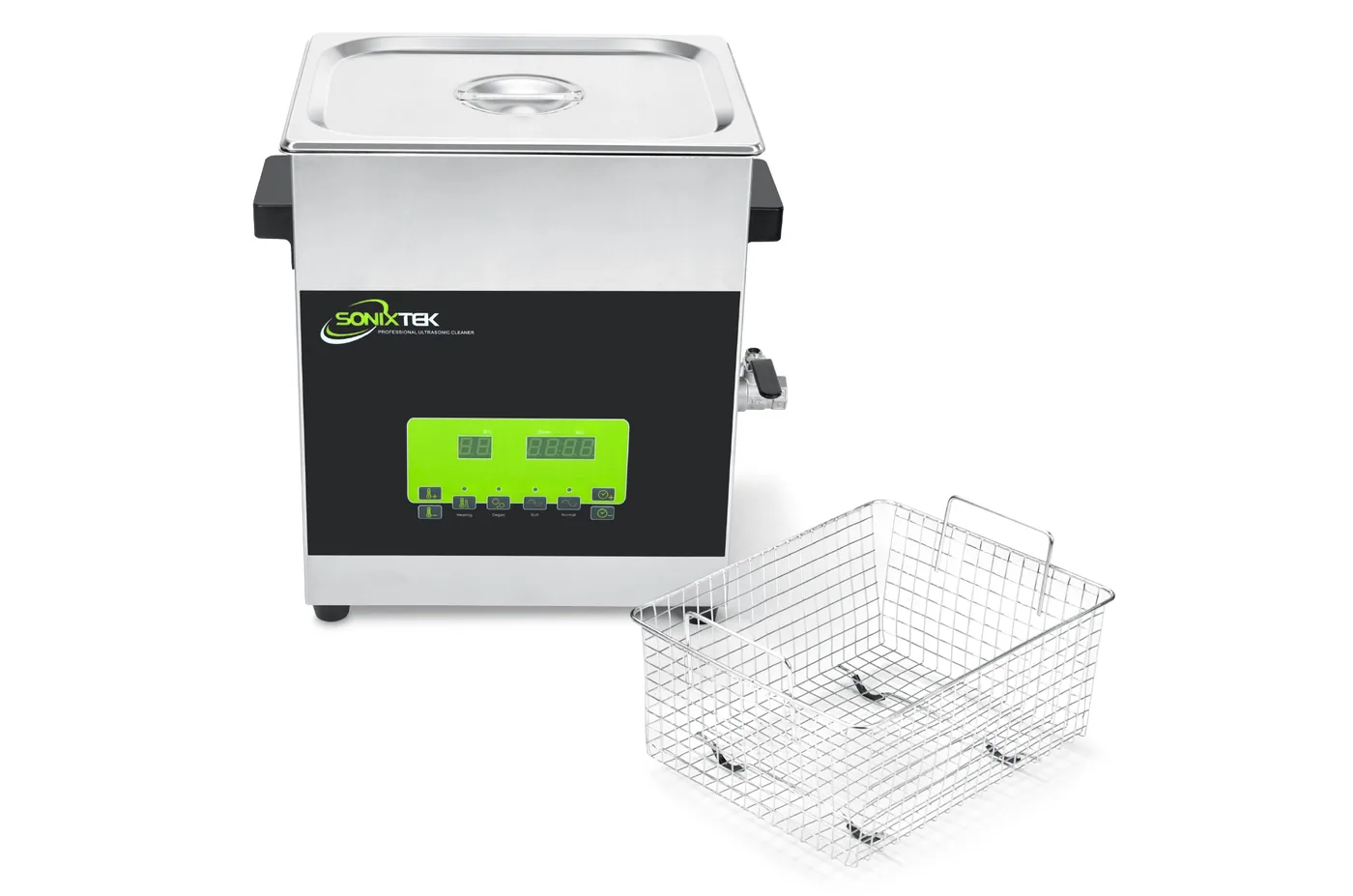
Injectors are small and are cleaned a set at a time, so this is benchtop work. An STS-150 or STS-150 PRO (15 L) holds a rack for a set of four to eight; an STS-300 (30 L) takes two sets or a set of large truck injectors. A garage that also cleans carburettors, throttle bodies and small parts often chooses a UMX Pro 50L instead, and stores one programme per job.
The bath will carry varnish and a trace of fuel; change it when the solution darkens, or put a small filtration loop on it if injectors are a daily job. For diesel injectors, which are a different process, see the diesel injector article.
What ultrasound will not fix
A burnt coil, a worn needle or seat that still leaks after cleaning, a cracked overmould, or an orifice eroded oversize. The flow test tells you which injectors are cleaned and which are worn out.