
Parts and contaminants · 9 min read · Updated 2026-11-16
Cleaning anilox rollers: tank, frequency and ceramic care
How to clean ceramic anilox rollers in an ultrasonic tank: sizing the tank to the roller, why 40 kHz, and the settings that protect the cells.
Technical guide. Figures are taken from our own spec tables; for your process we confirm the settings with a cleaning trial.
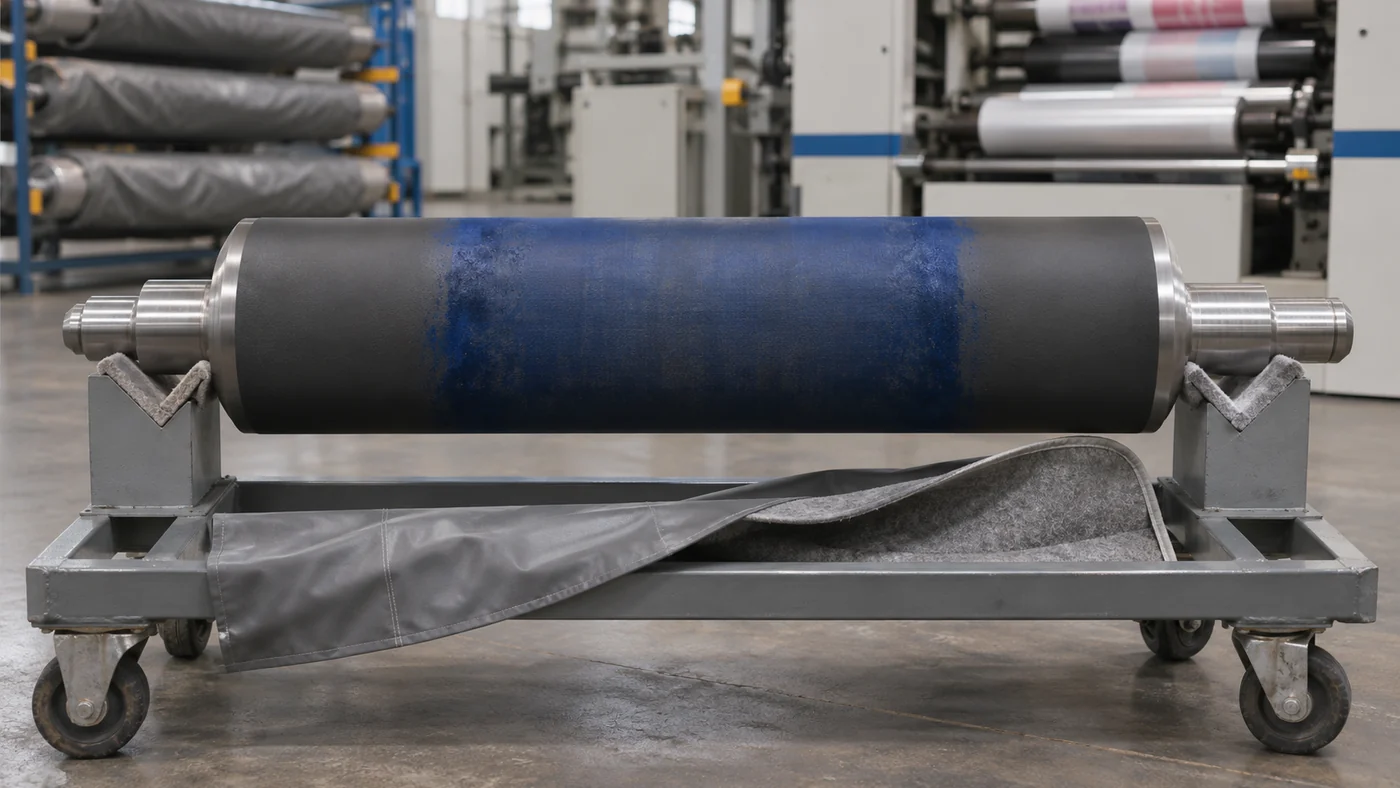
An anilox roller meters ink by volume. Its ceramic surface is engraved with cells, and every cell is meant to carry the same small amount of ink to the plate. When ink dries in the bottom of the cells, the roller carries less than its nominal volume and the print gets weaker, often before anything looks wrong on the surface. Ultrasound reaches into the cells where a brush does not.
How do you clean an anilox roller ultrasonically without harming the ceramic? Inspect the coating first, then clean at 40 kHz with the generator power turned down from the usual 15 W per litre, sweep on and a bath degassed for five to ten minutes. Change the temperature gradually, run short cycles, then rinse, dry straight away and check the cells under a microscope.
What sits in the cells
An anilox roller is a steel or aluminium core with a sprayed ceramic layer, usually chromium oxide, into which a laser engraves the cell pattern. The screen is given in lines per centimetre or per inch, the cell volume in cm³/m². The finer the screen, the smaller and shallower the cells and the thinner the walls between them.
What blocks the cells depends on the ink:
- Water-based inks and coatings dry to a film that softens again in an alkaline cleaner.
- Solvent-based inks leave binder residue. They need a cleaner made for them, never a flammable solvent in an open heated tank.
- UV-curing inks and varnishes that have cured in the cell are the hardest to remove. They need a cleaner formulated for cured UV material and usually more time.
- Adhesives and lacquers in converting behave like the coatings they are. The cleaner supplier names the product that dissolves them.
The chemistry softens the residue; the ultrasound does the mechanical part. Cavitation in the liquid inside each cell lifts what the cleaner has loosened, including from cell bottoms that no brush reaches.
Can ultrasound damage an anilox roller?
Ultrasound can damage an anilox roller when power, chemistry or temperature go beyond what the ceramic coating tolerates. The usual causes are a roller lying still over one group of transducers, a coating that is already cracked, the wrong cleaner, thermal shock and knocks. Standard industrial tanks run around 15 W per litre, set for parts in general.
Cavitation is erosive. Ceramic is hard, but the cell walls of a fine screen are thin, and a coating is only as sound as its weakest spot:
- Too much power in one place for too long. A roller lying still above a group of transducers takes more energy along that line.
- A coating that is already damaged. Scores, chips and cracks let liquid reach the core under the ceramic. Cleaning does not cause that damage, but it can make it worse. Inspect the roller first, and ask the roller maker before cleaning one with visible damage.
- The wrong chemistry. Strong alkali at high temperature attacks aluminium cores and some sealants; acids attack steel journals. The cleaner must suit the roller as well as the ink.
- Thermal shock. Steel and ceramic expand at different rates. A cold roller lowered into a hot bath, or a hot roller rinsed with cold water, puts stress on the coating. Change the temperature gradually.
- Handling. A roller set down on its face, or knocked against the tank rim, chips. The roller rests on its journals, never on the ceramic.
Roller makers publish cleaning guidance for their rollers, some of it with limits for frequency, power, temperature and chemistry. Where such limits exist, follow them. We size the tank and the generator to stay inside them.
Which frequency and settings protect anilox cells?
Our starting point for ceramic anilox rollers is 40 kHz, with the generator power turned down to what the roller maker allows, sweep on and a bath degassed for five to ten minutes after every fill. At 40 kHz each bubble collapse releases less energy than at 28 kHz. Cycles start short.
- 40 kHz. The bubbles are smaller and reach further into fine features. The 28 kHz or 40 kHz guide explains the difference.
- Power set to the job, not to maximum. For anilox rollers, turn the generator power down to what the roller maker allows and the result needs. The ST generator has power adjustment from 0 to 100 %; the AU series has a digital generator with sweep, degas and pulse modes.
- Sweep on. A fixed frequency builds standing waves with stripes of strong and weak cavitation. Sweep keeps the field moving, so the whole face sees the same exposure.
- Rotation. A roller that turns slowly in a cradle passes every cell through the same field, and it can run partly immersed, which keeps the bearing seats and journals out of the liquid. Ask us about a roller cradle for your tank.
- Temperature from the cleaner's data sheet, reached gradually. Bring the roller close to the bath temperature before it goes in.
- Short cycles, checked. Start short, look at the cells under a microscope, and extend only as far as needed. The right time depends on the ink, how long it has dried and the screen.
- A degassed bath. A fresh fill holds dissolved air that cushions cavitation. Degas for five to ten minutes after every fill.
Rinse, dry and check
After the wash, rinse the cleaner out of the cells with clean water, in a second tank or with a gentle spray, while the roller still turns. Dry it straight after the rinse, before rinse water dries in the cells or rust starts on the journals. We propose a hot-air drying tank from the DT series for rollers and sleeves that fit its chamber: a heating turbine moves warm air through the load at a temperature the roller maker allows; longer rollers get a drying station built to their length, or clean, oil-free compressed air while they turn. Protect the journals against rust if the roller goes into storage; our guide to preventing water spots and flash rust explains why drying cannot wait.
Then measure. The cell volume after cleaning, compared with the roller's specified volume, shows whether the cleaning worked. A volume gauge or the roller maker's measuring service gives the figure; a microscope shows whether residue is left in the cell bottoms. A roller that does not come back to its volume after cleaning may be worn rather than dirty.
What size of ultrasonic tank does an anilox roller need?
The ultrasonic tank for an anilox roller must take the overall roller length with journals and supports, and the diameter plus clearance on both sides. Short rollers and sleeves fit the tanks of the ST series, from 40 to 400 L
- Length: the overall roller length including journals, plus room for the supports at each end.
- Width: the roller diameter plus clearance on both sides, so the sound reaches the face and the roller goes in without touching the walls.
- Depth: full immersion needs the diameter, clearance underneath and liquid above. Partial immersion with rotation needs less liquid and keeps the bearing seats dry.
- Weight: the roller is lowered onto its supports by hoist or lift, not by hand.
Rollers and sleeves from narrow-web presses fit a tank from the ST series, in a standard size or built larger to order. Every ST is built for 28 or 40 kHz, chosen when ordering, and has a 1" drain valve.
The AU series lowers the load on a lift platform and runs the cycle from a PLC, so every roller gets the same programme.
| Model | Type | Capacity (L) | Usable tank L × W × H (mm) | Frequency (kHz) |
|---|---|---|---|---|
| ST-40 | Heated ultrasonic tank | 40 |
400 × |
28 or 40 |
| ST-400 | Heated ultrasonic tank | 400 |
1100 × |
28 or 40 |
| AU-3000 | Automatic system with lift platform | 3,000 |
1910 × |
28 or 40 |
Source: Sonixtek product data, Nov 2026.
Beyond that, or where a standard tank would waste bath volume around a long, slim roller, the tank is welded to the length the roller needs, and the transducers and heating are scaled to match. Our page on custom-built units lists what can be built around it: lift, rinse and drying stations, filtration. With filtration, a laminar flow return pushes floating ink residue and foam across the surface to the overflow, so the roller comes out through clean liquid.
Frequently asked questions
Can sleeves be cleaned in an ultrasonic tank?
Ask the sleeve maker first whether the sleeve may be immersed. The base of some sleeves is not meant to sit in a hot bath. Where immersion is allowed, a sleeve is usually cleaned on a mandrel, at a temperature the sleeve maker accepts.
How do I know the anilox roller is clean?
Measure the cell volume after cleaning and compare it with the roller's specified volume in cm³/m², using a volume gauge or the roller maker's measuring service. A microscope shows residue in the cell bottoms. A roller that does not recover its volume may be worn rather than dirty.
Which cleaner removes cured UV ink from anilox cells?
Cured UV inks and varnishes need a cleaner formulated for cured UV material and usually more time than water-based inks. The cleaner supplier names the product. Never use a flammable solvent in an open heated tank, and check that the cleaner suits the roller core.
Why degas the bath before cleaning a roller?
A freshly filled bath holds dissolved air that cushions cavitation and weakens the cleaning. Degas for five to ten minutes after every fill, before the first roller goes in.
What to send us for a quote
- Overall roller length, face length, diameter and journal dimensions, or a drawing.
- Weight of the heaviest roller, and core material (steel or aluminium).
- Screen range (lines per cm or inch) and cell volumes.
- Ink and coating types, and how long rollers stand before cleaning.
- Rollers per week, and how you clean them today.
- The roller maker's cleaning guidance, if you have it.
- Available floor space and the electrical supply at the site.
Send it through the quote form; we reply within one business day. More on cleaning in production plants is on our manufacturing page.