
Operation and maintenance · 4 min read · Updated 2026-09-25
Troubleshooting: the machine runs but the parts are not clean
Nine causes cover almost every case, and seven of them are the bath or the loading, not the machine. A checklist in the order that finds the fault fastest, from the sound of the tank to the generator display.
Technical guide. Figures are taken from our own spec tables; for your process we confirm the settings with a cleaning trial.
"The ultrasonic is not working" almost always means "the parts came out dirty". The machine is the last thing to suspect. Work down the list; each step takes a minute and most faults are found by step four.
1. Listen
A healthy tank at working temperature makes a sharp, even crackle with a hiss under it. A soft, fizzy sound with bubbles streaming to the surface is a gassy bath: fresh fill, cold, or standing overnight. Run the degas programme or ten minutes of ultrasound and listen again. This is the commonest cause of a bad first batch of the day.
2. Temperature
Read the display, then check the bath with a thermometer in the basket position. A cold bath cleans oil slowly; a bath above 80 °C cavitates weakly. If the display says 60 °C and the thermometer says 45, the heater is not keeping up or the probe is scaled. The temperature article has the target ranges.
3. Bath condition
Look at the surface for oil and foam, then at the liquid in a glass: cloudy grey means saturated with oil or particles. Titrate the concentration. A bath that has cleaned well for three weeks and then stops is a spent bath, not a broken machine. Change it, and note the batch count for next time; see bath life.
4. Loading
Parts touching or stacked, parts on the floor, blind holes facing straight down (an air pocket), a load that fills half the tank. Clean one part alone in the middle of the basket. If that one comes out clean, the fault is the loading.
5. Level
Liquid below the mark changes the tank's resonance and leaves the top of the load in the turbulent surface layer. Fill to the line; check that the basket and the parts are fully under with 30 to 50 mm of liquid above them.
6. Foil test
Now the machine. A foil test in a degassed, warm bath separates three cases:
- Even perforation: the machine is fine. Go back to chemistry, temperature and time; run a trial with a stronger cleaner or a longer cycle on one part.
- Bands: sweep off. Switch it on or, on an analog generator, accept the pattern and turn the parts mid-cycle.
- Blank patches or one blank zone: a transducer group or a generator channel is down. Continue below.
7. Generator
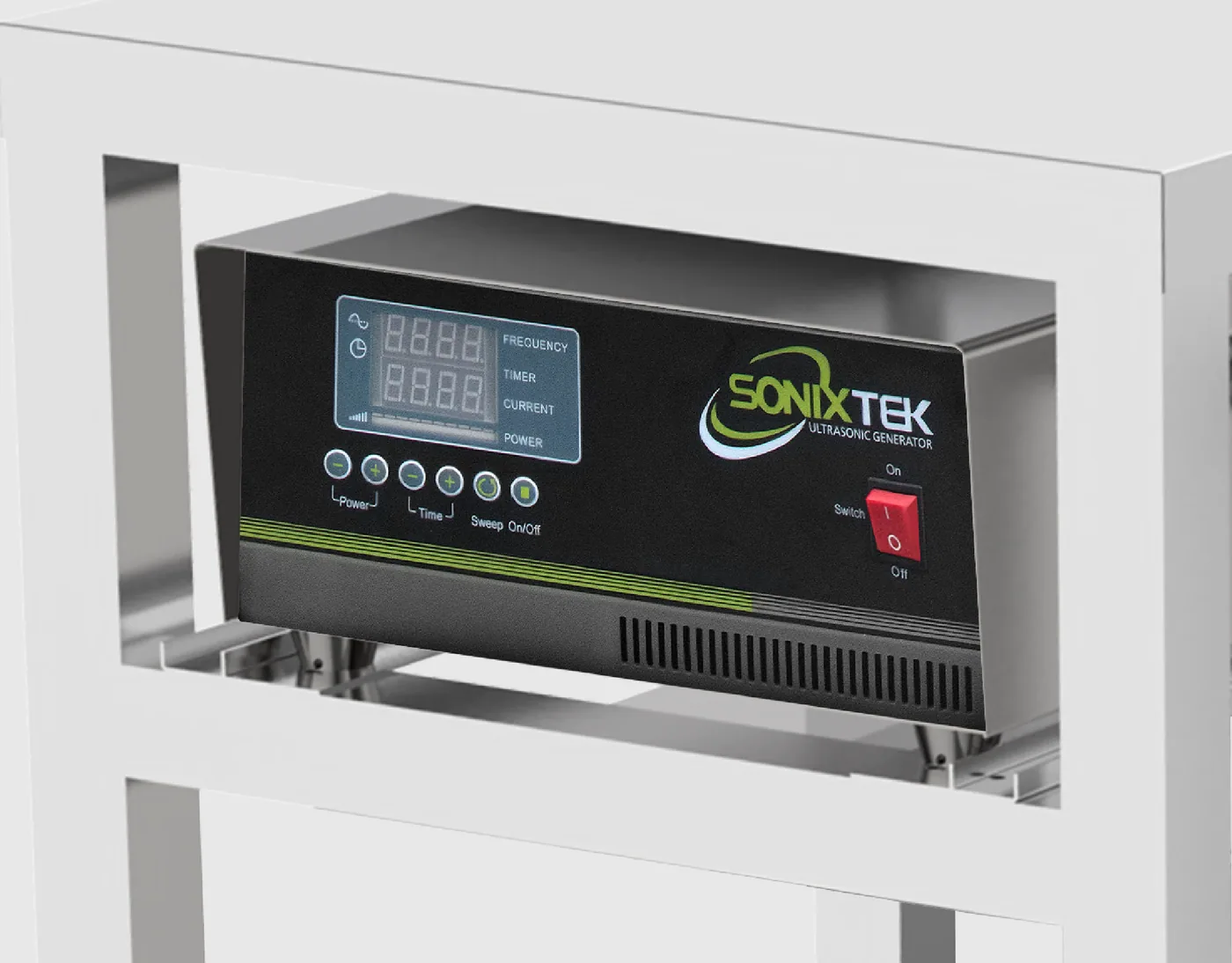
Read the generator display or indicator lights. On multi-generator tanks, note which unit shows a fault. Check the generator cabinet's fan runs and its vents are clear; generators reduce output when hot. Check the fuses. A generator that trips repeatedly under load is protecting itself against a transducer fault and should not be reset again and again.
8. Transducers
From below, with the machine off and isolated: look for a transducer that has come loose from the tank floor, a cable pulled from its terminal, or moisture in the transducer compartment from a leak. A single detached transducer leaves a blank patch on the foil the size of a hand; a leak takes out a whole group. Both are service jobs.
9. Frequency
Right frequency for the part? Heavy carbon on cast iron at 40 kHz takes twice the time of 28 kHz; fine flux residues at 28 kHz are cleaned less well than at 40 and the board may be damaged. The 28 or 40 kHz guide covers it.
When to call
After step 6 with blank patches, after any generator fault that recurs, after a leak. Have ready: the model and serial number, the foil, a photo of the generator display, the bath age and chemistry, and what changed recently. Most transducer and generator faults are repaired on site with a matched replacement set.
The chart
| Symptom | Most likely cause | First action |
|---|---|---|
| Bad first batch, fine later | gassy or cold bath | degas, preheat on timer |
| Gradual decline over weeks | spent bath or clogged filter | titrate, change bath, change filter |
| Clean edges, dirty centre | overloaded basket | one layer, gaps |
| Clean tops, dirty undersides | shadowing, no agitation | turn parts mid-cycle, or lift with agitation |
| Line at one height on every part | standing wave | sweep on, lower basket 10 mm |
| One zone of the tank weak | generator channel or transducer group | foil test, service |
| Everything weak, bath fine | level low, heater or generator derating | fill, check fan and vents |
| Parts damaged, matt or pitted | wrong frequency or cycle too long on soft alloy | 40 kHz, shorter cycle |
| Residue after drying | rinse missing or spent | see rinsing and drying |