
Choosing a machine · 7 min read · Updated 2026-11-16
Replacing solvent degreasing with aqueous ultrasonics
Replace solvent degreasing by assessing the complete wash, rinse and dry route: soil, material compatibility, bath control and checks on the part.
Technical guide. Figures are taken from our own spec tables; for your process we confirm the settings with a cleaning trial.
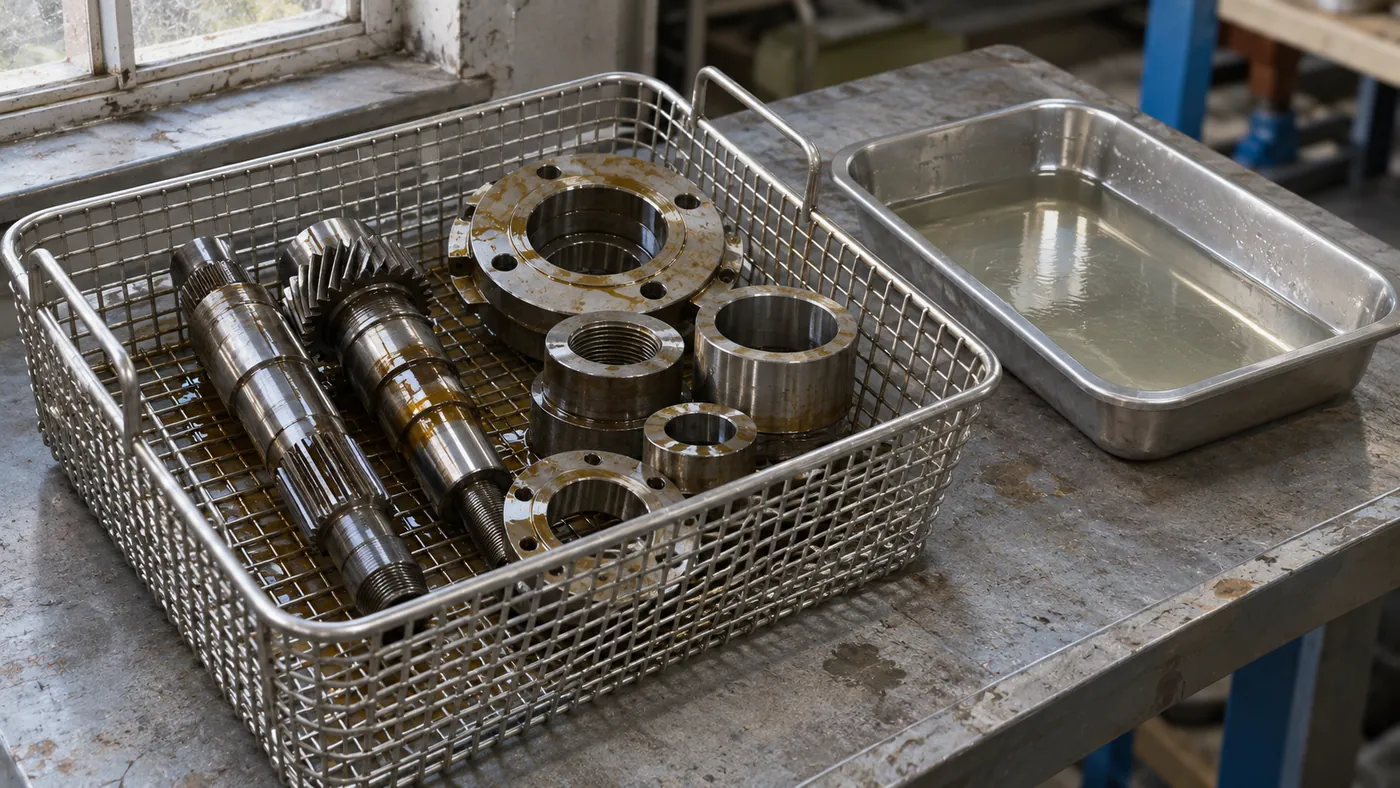
A solvent process often looks like one operation because the part appears dry soon after it leaves the bath. Water and detergent split that operation into three: the wash removes the soil, the rinse removes the wash solution, and the dryer empties the recesses before the part reaches assembly. Compare those complete routes before selecting a tank.
Can aqueous ultrasonic cleaning replace solvent degreasing? It can when the detergent removes the actual soil without affecting the part, and rinsing and drying deliver a part the next operation accepts. Start trials at 40 kHz for fine features and aluminium, or 28 kHz for heavy soil on robust parts, and prove the complete route on representative parts.
Which parts and soils should enter the first trial?
Start the aqueous trial with a known oil on a known material. Use 40 kHz for machined surfaces, threads, small bores and aluminium, and 28 kHz for heavy soil on robust parts such as castings. Include the least accessible recess and the finish that must be preserved. A clean open steel coupon proves nothing about a blind bore.
List the solvent's present jobs: dissolving the oil, carrying particles away, reaching a recess and leaving the part ready for its next operation. In the aqueous route the detergent deals with the soil; loading, rinsing and drying take over the other jobs. Wax, aged oil and cutting-fluid residue can need different detergents on the same alloy.
Record the seals, adhesives, coatings and mixed-metal contacts that stay on the part, and ask the detergent supplier to assess compatibility. Put rejected parts and the dirtiest incoming samples into the trial; lightly soiled pieces hide the conditions that decide the result. Parts that arrive dripping with neat oil should drain over a tray or pass a pre-wash first, so the ultrasonic tank works on the recesses rather than the bulk oil. The comparison of cleaning methods gives the general overview; this article covers the production route.
What replaces the solvent's wash-and-evaporate sequence?
An aqueous route separates washing, rinsing and drying: 40 kHz ultrasound assists the wash on fine features, clean rinse water removes carried-over detergent, and a dryer removes retained water. Each stage solves its own problem. A longer wash cannot correct a spent rinse, and extra drying heat leaves dissolved residue on the part.
Rinsing works by dilution. A part that carries 5 ml of wash solution into 50 litres
- Dip rinse: a tank of clean water next to the wash. Adequate when parts go on to machining or handling.
- Ultrasonic rinse: the same tank with ultrasound, which flushes the film out of blind holes and threads that a still dip leaves behind.
- Demineralised final rinse: water below about 20 µS/cm, used before painting, coating, bonding and optical or electronic assembly, so tap-water minerals do not dry as white spots.
- Inhibitor in the last rinse: protects bare steel that waits between cleaning and the next process. Check it against bonding or coating before you use it.
Put an inspection point after each stage. After washing, look for the original soil. After rinsing, look for detergent residue; streaks or a dull film usually mean the rinse is spent, so change it on a schedule tied to the wash bath. After drying and cooling, inspect the deepest pockets and the bonding, coating or assembly faces.
Drain parts above the wash before they move to the rinse, and load them so openings fill in the rinse and empty before the dryer. The rinsing and drying guide covers each stage in detail, and the loading guide covers part orientation.
How should the drying stage be specified?
The DT-96 hot-air dryer (96 L
| Model | Volume (L) | Basket L × W × H (mm) | Frequency (kHz) | Heater (W) | Air temperature (°C) |
|---|---|---|---|---|---|
| ST-96 | 96 |
580 × |
28 or 40 | – | – |
| DT-96 | 96 |
580 × |
– | 3,000 | 30 to 100 |
| SF-225 | 225 |
840 × |
28 or 40 | – | – |
Source: Sonixtek products.json and live product-copy snapshot, read 16 Nov 2026; only rows where both agree.
The ST-96 and DT-96 take the same basket, so one basket moves from wash to rinse to dryer without repacking. Every repacking step is a chance to turn a recess the wrong way. The SF-225 basket is 840 mm
Include inserts and fixtures in the drying trial. Fine mesh, pooled rinse water and tightly nested parts slow water removal even when the exposed faces look dry. Dry ferrous parts straight after the rinse, especially in a humid workshop, and choose any temporary corrosion protection with the next operation in mind.
How do filtration and oil separation affect the trial?
Filtration and oil separation keep the oil from one basket off the next. The SF-225 ultrasonic cleaner with filtration (225 L
Size the oil load before choosing the bath. Weigh a few parts before and after cleaning and multiply by the daily output. The oil and grease guide uses a working figure of about 3 g
A skimmer only takes oil that separates and floats. Some detergents hold the oil in an emulsion; a demulsifying detergent lets it separate so the skimmer can remove it. Choose detergent and oil separation together with the supplier. A particle filter takes out swarf and grit but does little for oil. Watch the bath across representative loads rather than planning on a fixed bath life.
The SF filtration range and AL basket-lift range offer different handling layouts; an ST tank suits evaluation of the wash itself.
Acceptance and the site review
Agree acceptance with the people responsible for the next operation, and test both routes on the same part family with the plant's existing method. Where none exists, a water-break test is a quick start: rinse the part in clean water and watch it drain. Water sheets evenly off a degreased surface and breaks into droplets on an oily one. Record loading, handling time, rejects and rework alongside the cleaning observations.
Ask the site's environment, health and safety team to review the detergent safety data sheet, exposure controls, handling and the resulting waste streams. Water-based chemistry still carries the removed oil and metals, so the review covers wash liquid, rinse water and separated oil. This article assigns no legal classification and assumes no disposal route or environmental saving.
Frequently asked questions
Can I leave out the rinse if the part looks clean?
Appearance does not show whether the detergent film has gone. The rinse removes carried-over solution and dissolved soil; extra drying cannot, because it leaves dissolved material on the surface. Assess the residue with the next operation's acceptance method before you shorten the route.
Will a skimmer remove every type of oil?
A skimmer takes oil that separates at the surface. If the detergent holds the oil in an emulsion, separation is limited. Choose detergent and oil separation together, then observe performance as real loads enter the bath rather than assuming a fixed service interval.
Does the dryer range set the part temperature?
The listed range describes the dryer. The part's materials set the allowed exposure, and retained water and loading set the drying task. A thermostat reading does not show the temperature inside a loaded part; check the least accessible feature after cooling.
What to send us for a quote
Send the existing route, the solvent and oil data sheets, materials, finishes, retained non-metal parts, largest dimensions and output per shift. Add the oil weight from a few parts, the present acceptance test, available space, utilities and the next operation.
Our technical team can compare wash tanks, rinse arrangements and DT dryers from the quote form. Share the proposed route with your site's EHS team and detergent supplier during trial planning.