Ultrasonic cleaning basics · 3 min read · Updated 2026-09-25
Cavitation: how a collapsing bubble cleans a surface
Ultrasound does not scrub. It makes millions of microscopic bubbles grow and collapse against the part every second, and the collapse does the work. What happens in the liquid, and what it means for the settings you choose.
Technical guide. Figures are taken from our own spec tables; for your process we confirm the settings with a cleaning trial.
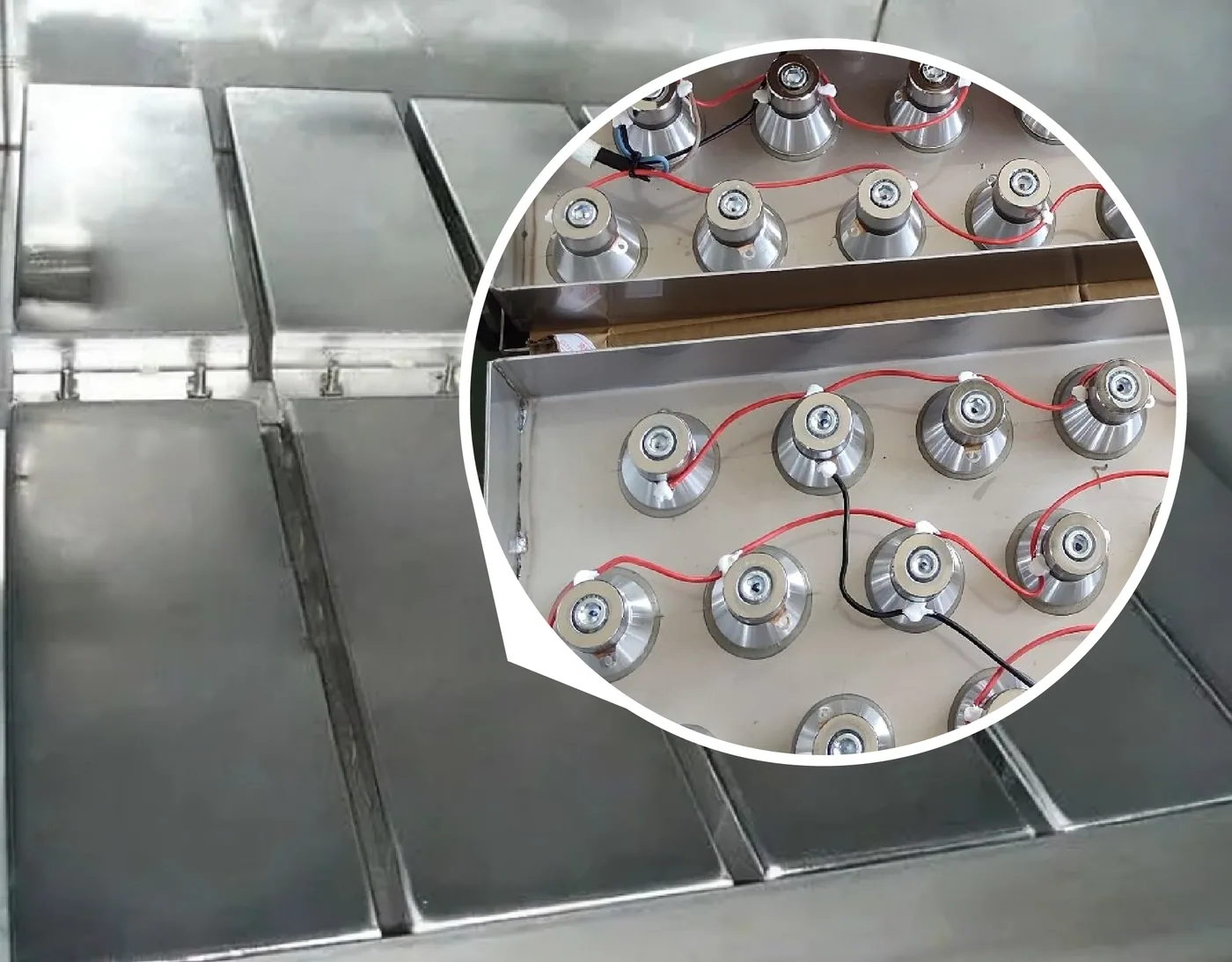
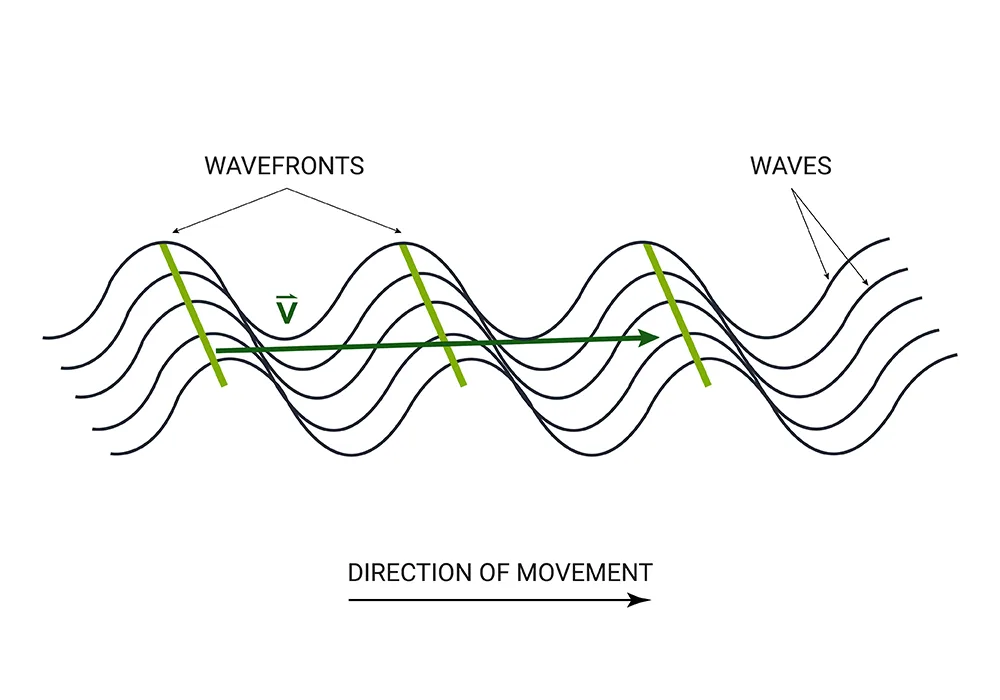
An ultrasonic cleaner has no moving parts in the liquid. The transducers under the tank floor push and pull the tank wall between 28 000 and 40 000 times a second, and that motion travels into the liquid as a pressure wave. Cleaning happens because of what the wave does to the liquid, not because of the wave itself.
The pressure wave tears the liquid open
A sound wave is a train of high-pressure and low-pressure half-cycles. In the low-pressure half, the liquid is pulled apart hard enough that microscopic voids open at weak points: dissolved gas, dust, a scratch on the part. Each void fills with vapour and gas and grows for a few cycles.
The bubble grows, then collapses
In the high-pressure half of the following cycle the bubble is crushed. Because a bubble collapses far faster than it grows, the energy stored in its wall arrives at one point in a fraction of a microsecond. Near a solid surface the collapse is asymmetric: the far wall of the bubble folds inward and shoots a liquid jet at the surface. Measured jet speeds run to hundreds of metres per second and the local pressure spike reaches hundreds of bar, over an area the size of the bubble.
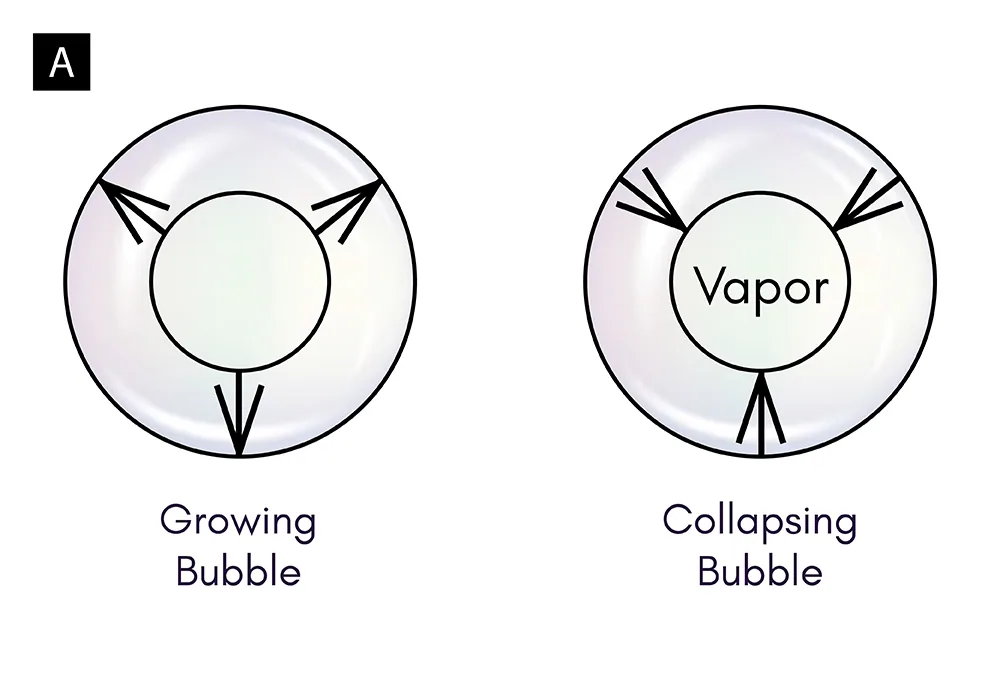
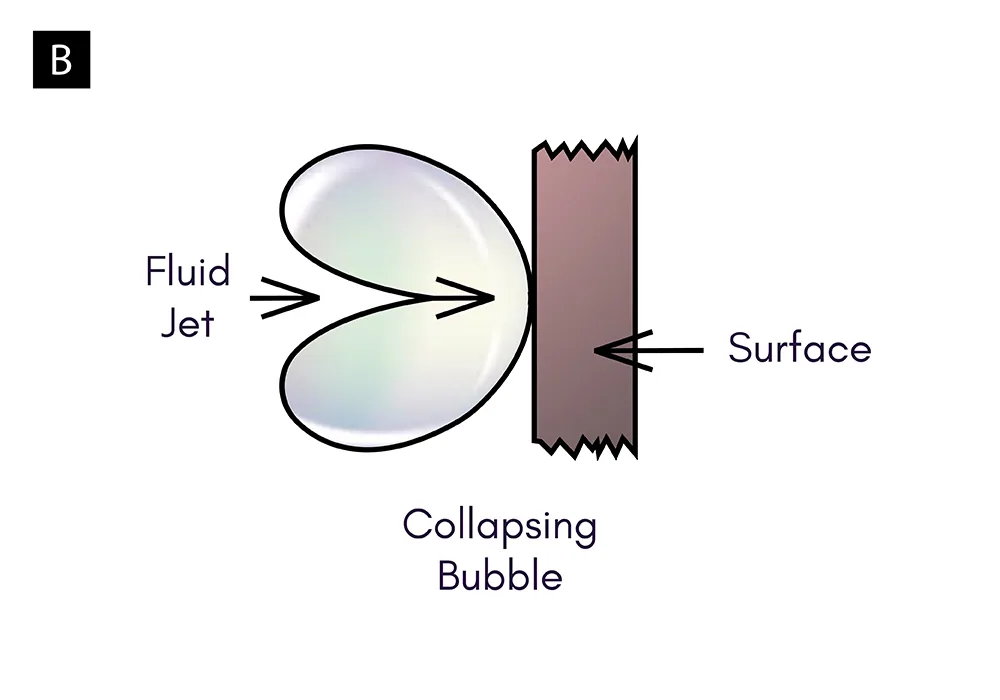
That jet is what lifts a film of oil, breaks a layer of carbon or knocks a chip out of a blind hole. Because bubbles form wherever there is liquid, they form inside bores, under heads of screws and in the threads of a nut. Nothing has to reach the spot; the liquid is already there.
Why the parameters matter
Every setting on the machine changes how the bubbles behave.
- Frequency sets the bubble size. At 28 kHz the bubbles are larger and collapse harder; at 40 kHz they are smaller, more numerous and gentler. The 28 or 40 kHz guide covers the choice.
- Temperature changes the vapour pressure and viscosity of the liquid. Cavitation is strongest in water around 50 to 60 °C; above about 80 °C the bubbles fill with vapour, cushion their own collapse and clean less, even though the chemistry works faster. Our ST tanks heat to 110 °C, but most cleaning runs between 45 and 65 °C.
- Dissolved gas cushions the collapse in the same way. A freshly filled tank cleans badly until the air has been driven out, which is what the degas cycle on a digital generator does in a few minutes.
- Surface tension and detergent decide how easily the voids open and how the lifted soil is carried away. Plain water cavitates, but a small amount of surfactant makes the process markedly more effective.
- Power density, the watts per litre, sets how many bubbles form per second in the volume. Our tanks run between about 9 and 40 W per litre depending on size; the power density article explains the spread.
What cavitation cannot do
A bubble collapses at the liquid-solid boundary. It cannot dissolve a material that the liquid cannot wet, so grease on a part that floats or a dry pocket of trapped air stays dirty; parts must be fully submerged and positioned so air can escape. Cavitation is also indifferent to what it hits: soft aluminium, anodised layers and polished surfaces can show a matt "cavitation erosion" after long cycles at 28 kHz, which is one reason to use 40 kHz and short cycles on finished surfaces.
Seeing it for yourself
A sheet of household aluminium foil held in the tank for one minute comes out perforated where cavitation is strong and untouched where it is weak. The foil test article explains how to read the pattern and how to use it to check a machine over its life.