Parts and contaminants · 5 min read · Updated 2026-09-30
Ultrasonic cleaning of circuit boards after soldering
Wash, deionised rinse, dry, test, coat: the full cleaning process for assembled boards after reflow, wave and hand soldering, and how to prove it worked.
Technical guide. Figures are taken from our own spec tables; for your process we confirm the settings with a cleaning trial.
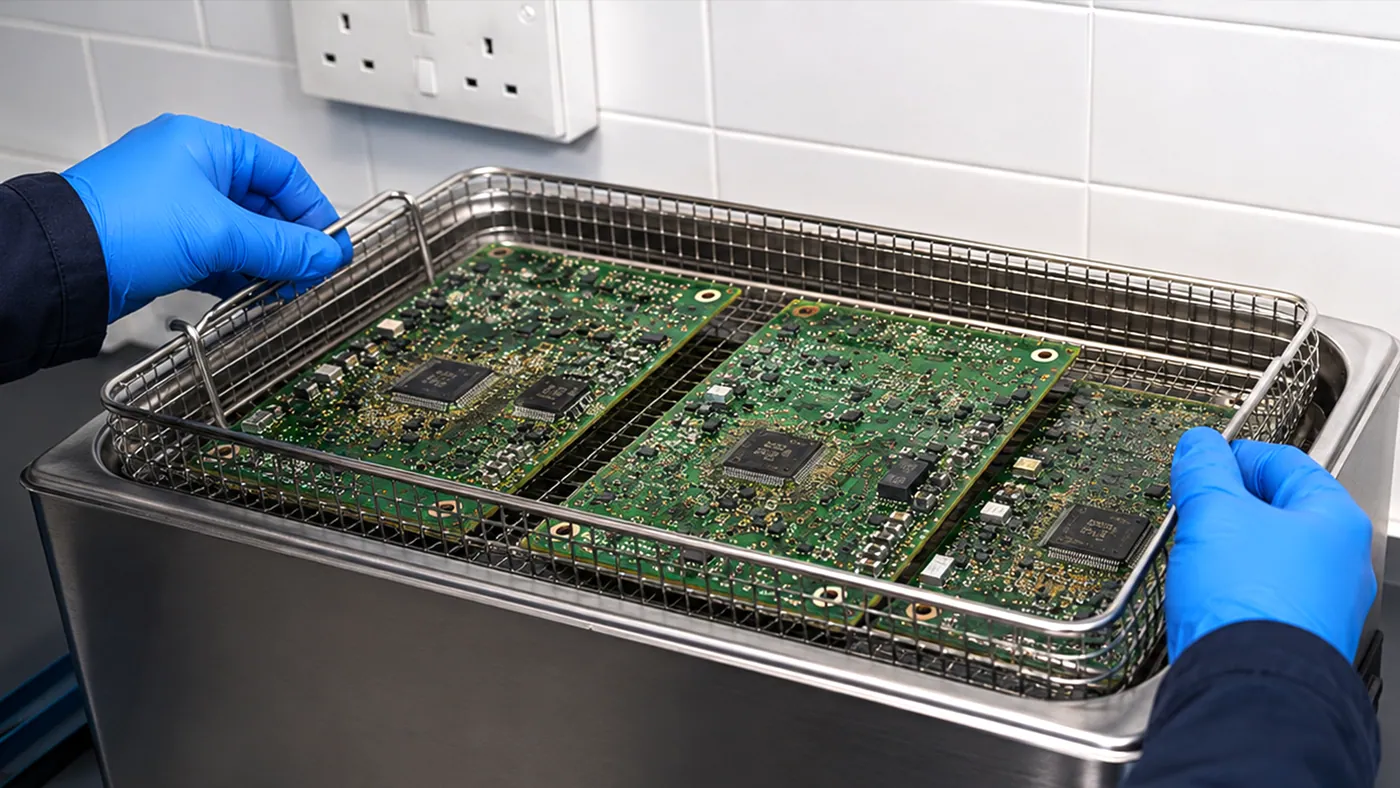
Cleaning an assembled board is a process with five steps, and the wash is only one of them. A board that was washed well but rinsed in tap water, or dried on the surface while water still sits under a QFN, can leave the line with more ionic contamination than it had before. This article covers the whole chain; the chemistry for each flux type is in removing flux residues.
What each soldering process leaves behind
| Process | Where the residue sits | What makes it hard |
|---|---|---|
| Reflow | Around every joint and under bottom-terminated parts (QFN, LGA, BGA) | Stand-off of 0.1 mm or less; residue is baked hard by the profile |
| Wave | Across the whole underside, through vias to the top side, on the pallet contact line | Large quantity; flux can be trapped under through-hole parts and in selective-solder pallet edges |
| Hand soldering and selective | Local, often heavy, around single joints | Flux that was not fully heated stays active; spatter spreads it beyond the joint |
Reflow boards need the bath to get under low stand-off parts; wave boards need a bath that can take a lot of flux before it is spent; hand-soldered boards carry partly activated residue, the most corrosive of the three.
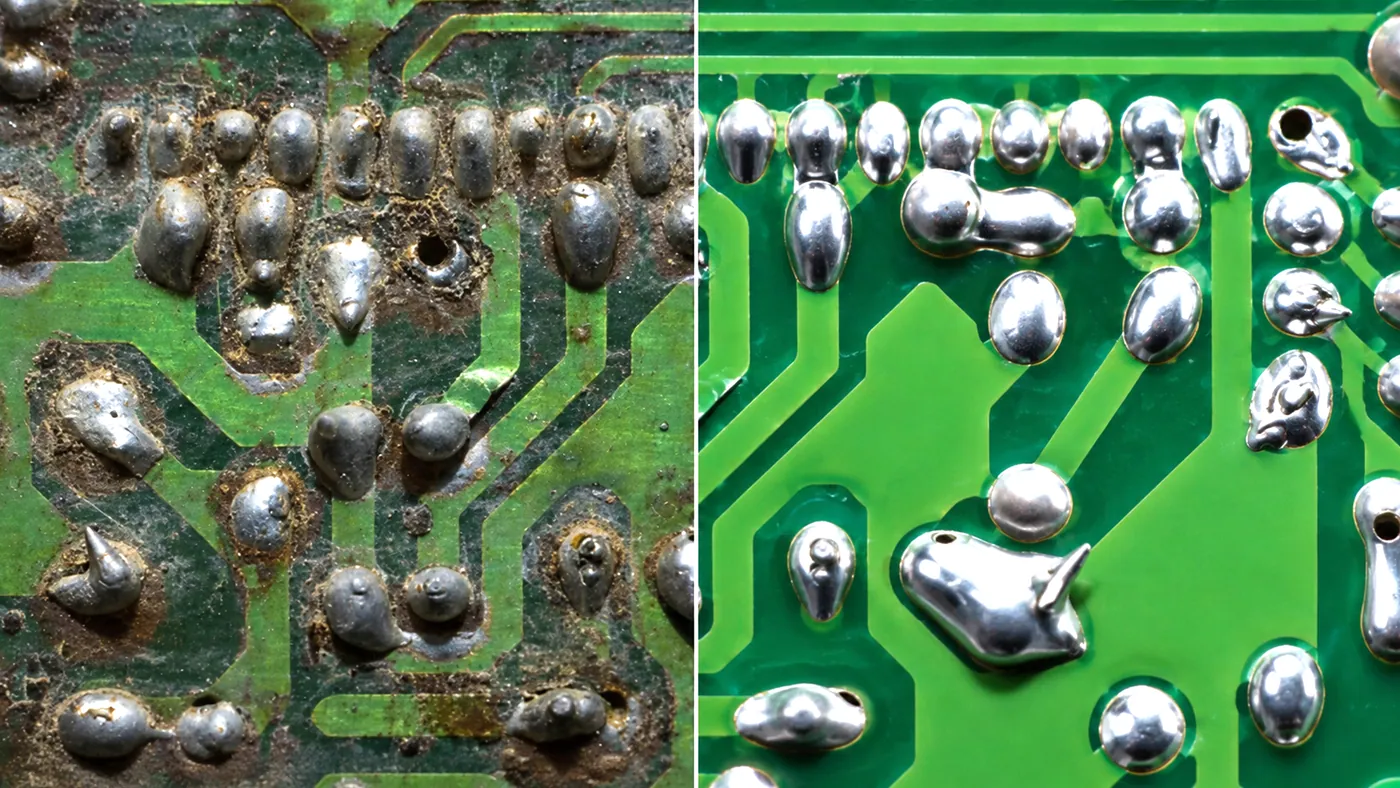
Step 1: wash
The wash chemistry follows the flux: a saponifier or engineered flux remover for rosin and no-clean, hot deionised water with a mild surfactant for water-soluble flux. Typical settings are 40 kHz, 45 to 55 °C and 3 to 6 minutes with sweep on. Stand the boards on edge in a rack, component side facing the transducers or vertical, with at least one board thickness of gap between boards so the liquid can move. Boards lying flat on each other shield the lower one completely; see loading the basket.
A fresh bath is full of dissolved air that absorbs cavitation energy under the components. Degas before the first load; see sweep and degas.
Step 2: rinse in deionised water
The rinse removes the wash chemistry and the dissolved flux that it now carries. Both are ionic, and both are what the cleaning was meant to take off.
- Rinse 1: deionised water, warm, with ultrasound, 2 to 3 minutes. This is the stage that flushes saponified residue from under components.
- Rinse 2: clean deionised water, without ultrasound or briefly with it, as the final rinse.
Measure the final rinse with a conductivity or resistivity meter and change or regenerate the water on that reading, not on a calendar. Tap water is never used on a board.
Step 3: dry
Drying a board is harder than drying a metal part because the water sits where the air cannot reach: under BGAs and QFNs, inside connectors and in unplated holes. The surface dries in minutes and the board still holds water underneath.
- Drain the rack over the rinse tank for a minute, boards on edge.
- Blow off with clean, dry, oil-free compressed air, angled under the large components.
- Dry in warm filtered air at 50 to 60 °C, 15 to 30 minutes, longer for boards with many bottom-terminated parts. Stay inside the lowest temperature limit on the bill of materials; displays, some connectors and batteries set it.
Water under a component dries last and leaves behind whatever the final rinse contained; see rinsing and drying.
Step 4: test the cleanliness
The common test methods are described in IPC-TM-650 and are referenced by J-STD-001:
| Method | What it measures | Use |
|---|---|---|
| ROSE (resistivity of solvent extract) | Total ionic residue extracted from the whole board, as a single figure | Quick process-control check, shift by shift |
| Ion chromatography | Individual ions (chloride, bromide, weak organic acids and others) | Qualifying a process, investigating a failure |
| Surface insulation resistance (SIR) | Whether the residue left on a test board leaks current under heat and humidity | Qualifying the combination of flux, process and cleaning |
| Visual, UV lamp, microscope | Visible residue, white deposits, rosin under UV | Every batch, on sample boards |
Recent editions of J-STD-001 moved away from a single ROSE pass mark towards qualifying the process with objective evidence, such as SIR data. The limit comes from your customer's specification and the edition it names. What the machine contributes is repeatability: the same programme, bath condition and rinse quality every shift.
Step 5: prepare for conformal coating
Conformal coating is the most common reason to install a board-cleaning line. A coating applied over flux residue, even no-clean residue, can dewet, lift or trap ionic material underneath, where it causes the failure the coating was meant to prevent.
- Clean, rinse and dry as above; the board must be dry under the components, not only on top.
- Coat within hours, not days. Store cleaned boards covered, in a clean area.
- Handle only with clean gloves and by the edges.
- Mask after cleaning, so the cleaning does not attack the masking material.
- The coating supplier's data sheet states the surface condition the coating needs. IPC-CC-830 covers the qualification of the coating itself.
What stays out of the bath
Unsealed relays and switches, MEMS microphones and sensors, some quartz crystals, displays and anything marked "no ultrasonic cleaning" are fitted after cleaning, masked, or the board is cleaned by hand. The precision electronics risk guide has the full list.
Which machine
| Work | Set-up |
|---|---|
| Rework bench, prototypes, small batches | STS-060 (6 L, 180 W) to STS-150 (15 L, 360 W), 40 kHz, boards on edge; a second unit or a beaker of deionised water as rinse |
| Larger boards, benchtop | STS-200 or STS-300, tank 500 × 300 mm, 40 kHz |
| Production cleaning, programmes per board family | UMX Pro 50L, 62L or 88L at 40 kHz, adjustable power, sweep and degas as standard; deionised rinse tank; drying cabinet or DT-96 |
| Wash, rinse and dry in one frame for small assemblies | MT-75, 75 L, 40/80 kHz |
For modules that come back from the field rather than off the line, see cleaning electronic modules after repair. The electronics industry page collects the related articles.