
Operation and maintenance · 7 min read · Updated 2026-11-16
Monitoring a cleaning bath: concentration, oil and change
Weekly titration, an oil balance in grams, a filter routine and a batch log: how to monitor an ultrasonic cleaning bath and decide when to change it.
Technical guide. Figures are taken from our own spec tables; for your process we confirm the settings with a cleaning trial.
A cleaning bath fails in three ways. Its chemistry is used up, it saturates with oil, or it fills with particles. Each has its own check, and colour tells you little about any of them. A dark bath can still clean; a clear bath at half strength cleans slowly and leaves residue.
How do you monitor an ultrasonic cleaning bath? Titrate the concentration once a week with the cleaner supplier's kit, which takes about 5 min. Watch the oil load in grams per litre, skim daily and look at a sample in a glass. Change the filter bag weekly. Log the batches between changes; that count becomes your change interval.
How often should you check the concentration of an ultrasonic bath?
Check the concentration of an ultrasonic bath once a week with the titration kit of the cleaner supplier; the test takes about 5 min. Correct a low reading with solution at working strength, not water alone. A bath at half strength is the commonest cause of "it used to clean better".
Titration is the reference method in our guides because the kit is matched to the cleaner. Follow the supplier's sample size, reagent and end point exactly, and take the sample at the same place and temperature each time. Too much cleaner is no fix either: above the recommended concentration most cleaners gain little, leave more residue and cost more to rinse off. The cleaning-liquids guide lists typical concentrations per soil.
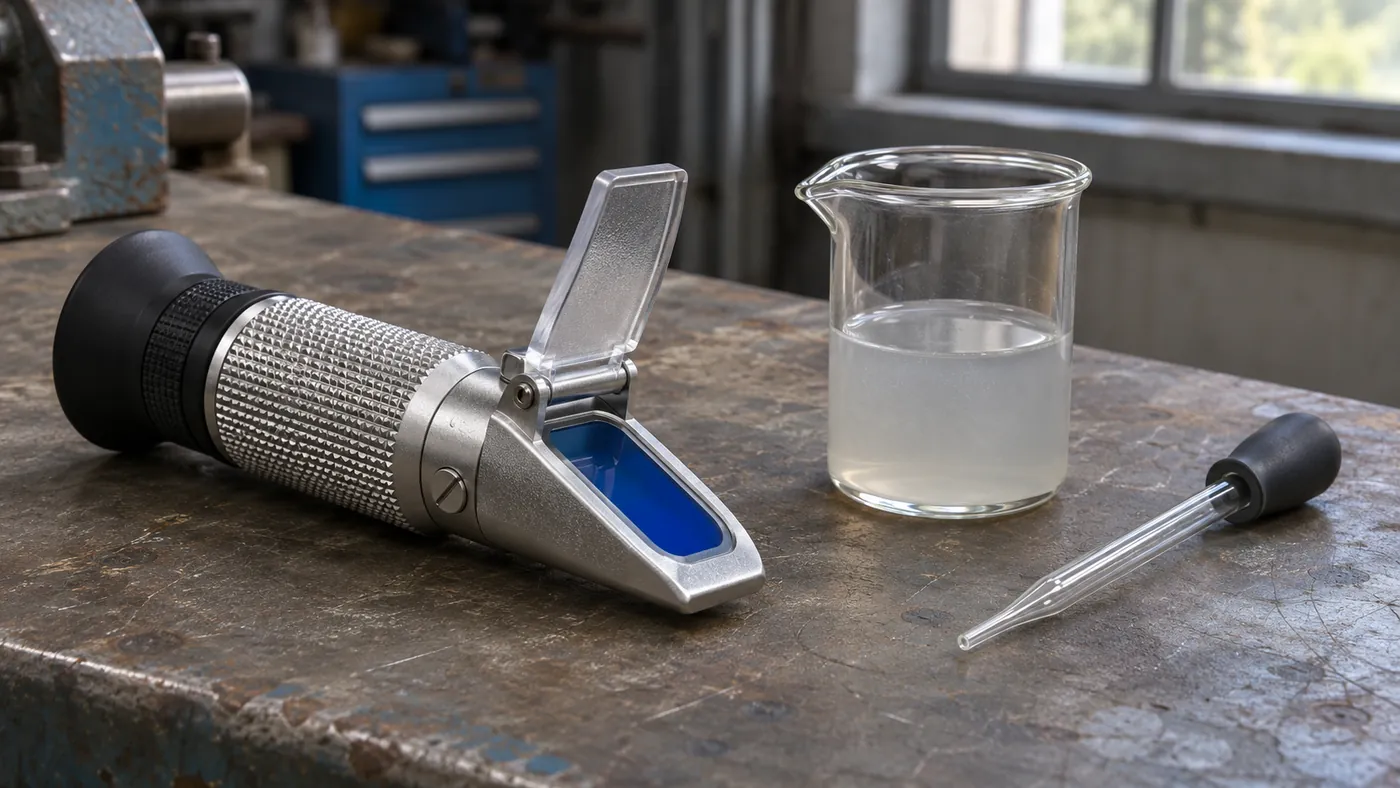
A refractometer gives a reading in seconds, which makes it tempting for a daily check. Use it only with the conversion the supplier gives for that cleaner. The reading responds to everything dissolved in the bath, soil included, so in an aged bath it can overstate the cleaner. Keep the weekly titration as the reference and compare both readings over a few bath lives.
Conductivity belongs mainly to the rinse. Our rinsing and drying guide gives below about 20 µS/cm for a demineralised final rinse before painting, coating or assembly. A rising rinse reading shows that cleaner is being carried over from the wash. Use conductivity on the wash bath only if the supplier specifies it.
| Check | Method | When |
|---|---|---|
| Floating oil | Skim, or let the skimmer run | Daily, at shutdown |
| Concentration | Supplier's titration kit, about 5 min | Weekly |
| Particle filter (5 to 50 µm) | Change the bag or check cartridge pressure | Weekly |
| Skimmer oil container | Empty it | Weekly |
| Floor sludge | Draw off briefly through the floor valve | Weekly |
| Bath change | Titration result and batch count | As your log shows |
Source: Sonixtek guides "Daily and weekly maintenance" and "Filtration and bath life", read 16 Nov 2026.
How much oil can an ultrasonic cleaning bath hold?
An alkaline ultrasonic cleaning bath emulsifies a few grams of oil per litre before it saturates; our guides use 3 g/L as a working figure. A 100 L
Oil saturation and concentration are separate limits. Adding concentrate does not restore the oil capacity of a saturated bath. The parts tell you first: they look clean in the tank and feel greasy on the bench. Pour a sample into a glass; cloudy grey means the bath is saturated with oil or particles. A water-break test on a rinsed part confirms it: water sheets off a degreased surface and breaks into droplets on an oily one.
To know how fast your bath fills, weigh a few parts before and after cleaning. The difference is the oil each part carries in. The oil and grease guide works this through:
| Oil balance | Example |
|---|---|
| Parts per day | 400 |
| Oil carried in per part | 1.5 g |
| Oil into the bath per day | 600 g |
| 225 L |
about 700 g |
Source: Sonixtek guide "Removing oil and grease", worked example, read 16 Nov 2026.
Without oil removal, that bath is spent in a little over a day. When the bath stands, most emulsified oil separates and floats within an hour. Let the bath settle overnight and skim in the morning, and the bath keeps its capacity for the day's work. Letting parts drip before they reach the cleaner cuts the load at the source.
What does the particle filter tell you about the bath?
A particle filter of 5 to 50 µm holds back swarf, grit and carbon flakes; the filter does not measure concentration and does little for emulsified oil. Change the bag weekly or check the differential pressure on a cartridge. A filter that blocks sooner than usual shows that more particles are arriving with the parts.
Particles matter because the fine fraction stays in suspension. It scatters the sound, so cleaning power drops, and it settles back on the parts as they are lifted through the surface. Our filtration and bath-life guide gives three to five turnovers of the tank volume per hour as a working figure for the loop.
The heaviest particles sink below the reach of any filter. Open the floor valve briefly into a bucket to draw off that sludge, then top up. If the edges of a basket come out clean and the centre does not, look at the loading before you blame the bath; the troubleshooting guide separates the two.
Top up by cause: water or solution
Evaporation removes water; carry-over removes working solution with its cleaner. Top up evaporation with water, and carry-over with solution at working concentration. Topping up water alone is the commonest way a bath drifts to half strength. A lid cuts evaporation, which is also the main heat loss.
A dosing pump adds detergent from a canister in a set ratio when the tank is filled or topped up. It can also re-dose on a timer or after a set number of cycles. That keeps the routine consistent where several operators run the machine. The pump adds; it does not measure. The weekly titration still checks the result.
When should you change an ultrasonic cleaning bath?
Change an ultrasonic cleaning bath when titration, oil load or the part result shows it is spent, not by colour. Our filtration guide gives two to four weeks for a filtered degreasing bath at 60 °C
Log the fill date, every titration result and correction, and the batches cleaned. After a few cycles the batch count between changes settles and becomes your maintenance interval. A bath that cleaned well for three weeks and then stops is usually a spent bath, not a fault in the machine. Gradual decline over weeks points to the bath or a clogged filter: titrate, change the bath, change the filter.
At the change, drain fully and wipe the floor and walls with a soft cloth. Look at the floor above the transducers for matt patches of cavitation erosion. Titrate the fresh fill so that the first reading of the log is a known reference. The daily and weekly maintenance guide has the full routine. A spent bath carries oil and metal fines; it goes to a licensed collector, not the drain.
For daily production, the manufacturing overview shows where the bath sits in the line. SF filtration units are built around the loop, with a buffer tank and skimmer. On ST industrial tanks a skimmer and a stand-alone loop can be added. On AL basket-lift systems filtration is a module.
Frequently asked questions
Can a refractometer replace titration?
Only if the cleaner supplier gives a refractometer conversion for that product. The reading responds to dissolved soil as well as cleaner, so it can overstate an aged bath. Use it for quick checks and keep the weekly titration as the reference.
Does a dosing pump make titration unnecessary?
No. The dosing pump adds detergent in a set ratio when the tank is filled or topped up, or on a timer or cycle count. It does not measure the bath, so the weekly titration still confirms the concentration.
Must a dark bath be changed straight away?
Not on colour alone. Pour a sample into a glass: cloudy grey means saturated with oil or particles. Titrate it and run a water-break test on a cleaned part. Change the bath when either check fails.
What to send us for a quote
- Cleaner and working concentration
- Parts per day and oil carried in per part, weighed before and after cleaning
- Present filtration, skimming and bath-change log
- Rinse stages and the acceptance check on the part
Our technical team will size the filtration, skimming and dosing from your quote enquiry.