
Ultrasonic cleaning basics · 3 min read · Updated 2026-09-25
Transducers and generators: what drives the tank
The generator makes the electrical signal, the transducers turn it into motion of the tank wall. How the two are matched, why the transducer count grows with tank size, and when an immersible box beats bonded transducers.
Technical guide. Figures are taken from our own spec tables; for your process we confirm the settings with a cleaning trial.
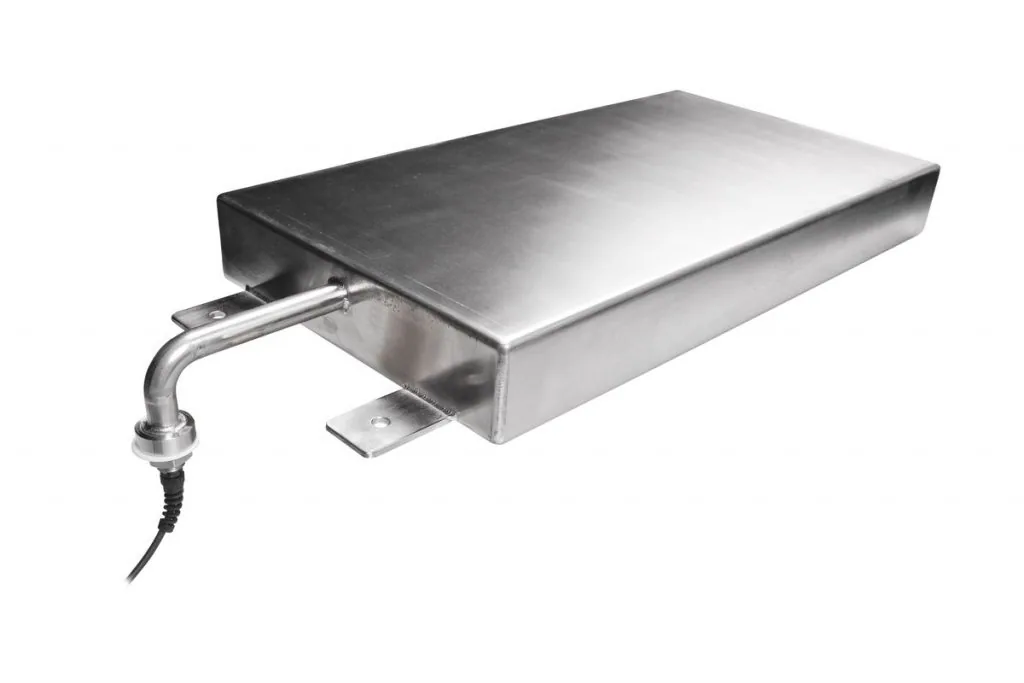
Every ultrasonic cleaner is two components in series: a generator that produces a high-frequency electrical signal, and a set of transducers that convert that signal into mechanical motion of the tank wall. Everything else, tank, heater, basket, lid, filtration, is there to support the process those two create.
The generator
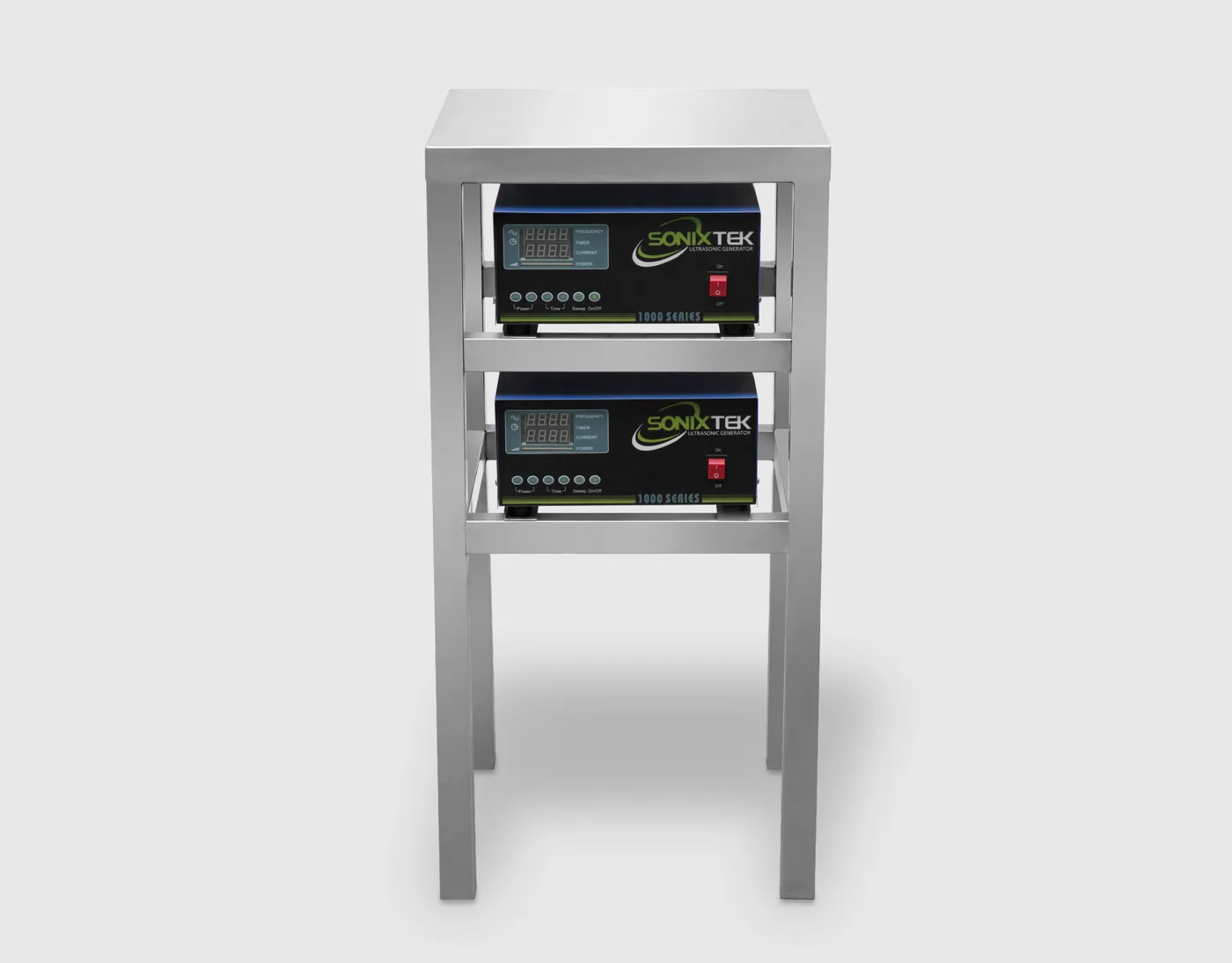
The generator takes mains power and produces a sine wave at the working frequency, 28 or 40 kHz on our industrial machines and 40 kHz on the benchtop STS range, at a power set by the number of transducers it drives. Generator and transducers are matched to each other: the resonant frequency of a transducer shifts with temperature and with the load in the tank, so the drive has to suit the transducers it feeds, and some digital generators also follow that shift during operation.
Our ST tanks up to the ST-157 run on one generator; the ST-206 and ST-300 use two and three generators of 1500 W, and the ST-400 three of 2400 W. Large AL and AU systems use up to ten generators of 2400 W. Splitting the power this way keeps each generator at a size that cools passively, and it means a fault in one unit takes out a fraction of the tank, not all of it.
Generators come in an analog and a digital version. The analog or digital guide covers the practical difference; in short, the digital generator adds sweep, degas, adjustable power and a route to a test report, and it is the one we quote for regulated buyers.
The transducers
A transducer is a stack of piezoelectric ceramic rings clamped between a steel back mass and an aluminium or titanium horn. When the ceramic sees the generator's voltage it expands and contracts by a few micrometres; the stack is tuned so that this motion resonates at the working frequency. The horn is bonded to the tank floor, and the floor becomes the radiating surface.
The transducer count is what scales the machine. One of our industrial transducers radiates around 60 W, so the count follows the tank:
| Model | Tank volume | Transducers | Ultrasonic power |
|---|---|---|---|
| ST-40 | 40 L | 12 | 720 W |
| ST-96 | 96 L | 24 | 1440 W |
| ST-206 | 206 L | 42 | 2520 W |
| ST-400 | 400 L | 96 | 5760 W |
| AL-1000 | 1000 L | 200 | 12 000 W |
| AU-8000 | 8000 L | 1160 | 69 600 W |
Transducers are spread across the tank floor, and on deep tanks along the side walls as well, so that the sound field is even. A tank with too few transducers for its depth cleans well near the floor and weakly at the surface; the power density article shows how the ratio changes with size.
Bonded transducers or an immersible box
On standard tanks the transducers are bonded directly to the underside of the tank floor. This is compact, efficient and the right choice when the tank is built for ultrasonic cleaning from the start.
An immersible transducer box is a sealed stainless steel case with the transducers inside, connected to the generator by a cable and placed in the liquid. It is the choice when:
- the tank already exists, for example a customer's own dip tank or a plating line;
- the tank is too large or too irregular to bond transducers evenly;
- the box has to be removed for maintenance without draining the tank;
- the sound has to come from the side or from above, as in some multi-tank lines.
Our SF series uses transducer boxes as standard, which is also what allows its laminar-flow filtration to circulate the whole tank volume without dead zones behind bonded transducers.
Matching the two
A generator and its transducers are a tuned pair. Swapping a transducer for one of another rating, or adding transducers to a tank, means re-matching the generator, which is why replacements are supplied as matched sets. Over its life a transducer's bond can fatigue; a tank that has lost some of its cavitation shows it first on the foil test as dead patches on the floor.