
Ultrasonic cleaning basics · 2 min read · Updated 2026-09-25
Analog or digital generator?
The same transducers, driven two different ways. What changes in daily use, and which one to specify.
Technical guide. Figures are taken from our own spec tables; for your process we confirm the settings with a cleaning trial.
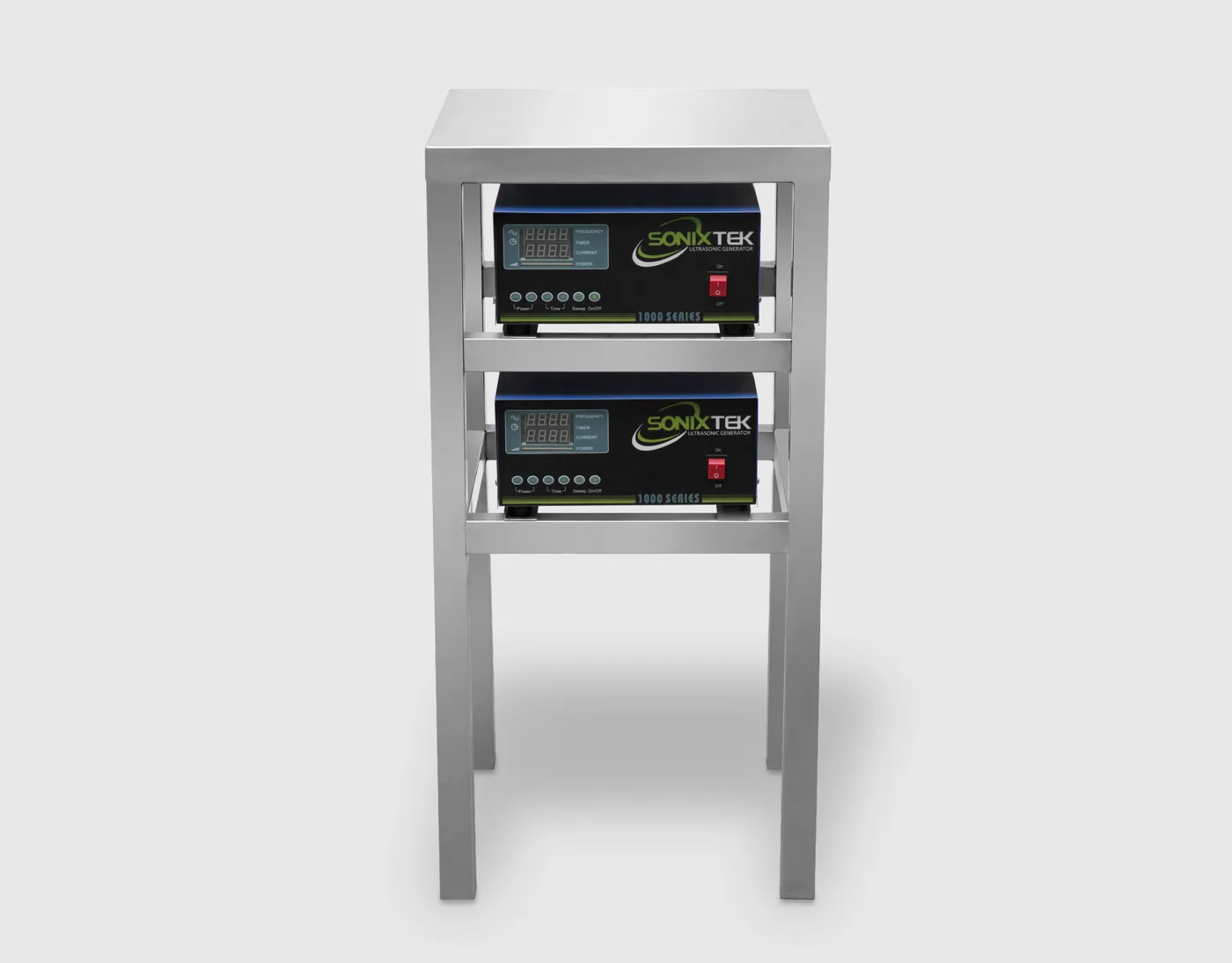
The job of the generator
The transducers bonded to the tank floor only vibrate when they are fed a high-frequency signal at the right power. The generator makes that signal from the mains. On every Sonixtek industrial tank it sits in its own housing outside the tank, where it stays cool, can be reached for service, and can be swapped without draining the bath.
Analog
An analog generator is tuned to the tank's resonance at the factory and set with a dial. It has few parts, tolerates dust and heat, and is the most economical to buy and to repair. Its limit is that resonance drifts as the bath warms up and the load changes, and an analog unit cannot follow that drift; the output it delivers into a cold, heavily loaded tank is not the output it delivers an hour later.
Digital
A digital generator controls power and frequency electronically. Sweep and degas are built in rather than added, pulse and power-step modes are available, and the unit reports its own state. That is also what makes programmes, touchscreen control and remote diagnostics possible on the AL and AU series.
Which to specify
One part, one soil, one operator: analog does the job and costs less over its life. Loads that vary, several recipes, or a process that has to be repeatable and traceable: digital. If your plant requires documented electrical testing, ask for the digital version.
Changing your mind later
Because the generator is external, an ST tank ordered with an analog unit can be upgraded to digital in the field. The transducers stay; the housing is exchanged. Ask us for the upgrade path when you order, and we will size the generator so the option stays open.